Quilt National 2013

Here’s some more of my impressions of Quilt National 2013, full quilt pictures, and some of the other events that weekend. Again, I always think you should buy the book. We should support the institutions that support us the best we can.

There were many opportunities to look at and photograph the art, yet I still find there were some I missed, especially as I was reviewing my mom’s pictures, realizing I didn’t really look at everything. At some point, I think it’s just overwhelming. I’m only going to provide artist links to those I didn’t link to in the last Quilt National post, mostly for my own sanity (there are LOTS of them!). So go back to HERE to the Artist Talks post if you think there should be a link and there isn’t.

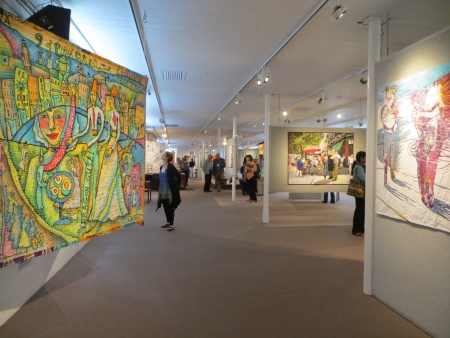
Here are some general views of the space, which was large and open. In this photo, you can see the right side of Robin Schwalb’s Jive Boss Sweat, then the right side of Barbara Schneider’s Forest Floor, var. 2. To the right is Susan Brook’s Together and Sandy Gregg’s Listen to the Rhythm of the Falling Rain. Way in the back, you can just see Katherine Knauer’s Solar City. In the forefront is Kate Sturman Gorman’s Bernadette in Artichokes, with Dinah Sargeant’s Old Child and Paula Kovarik’s Round and Round It Goes barely visible to the right.

May 27 13 001 small
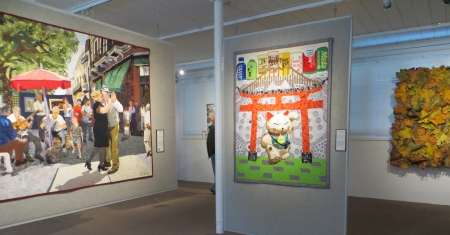
In this photo, most of Susan V. Polansky’s piece No One But You is visible on the left, and now you can see all of Robin Schwalb’s Jive Boss Sweat, then the left side of Barbara Schneider’s Forest Floor, var. 2. Polansky said that her quilt was about being lost in the moment. She said it took 3 years to make the quilt, that she had so many distractions going on, but that celebrating the moment was part of what the quilt was about.
May 27 13 002 small
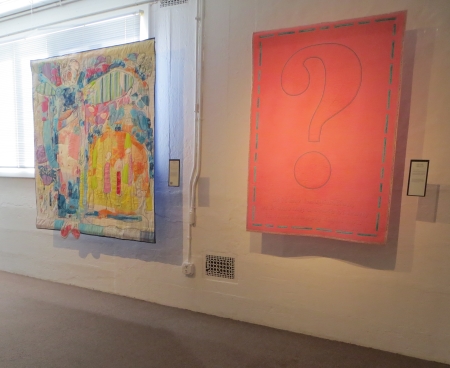
On the left is Anne Smith’s quirky Gabriel and on the right is Leslie A. Hall’s Casual Query #3.
May 27 13 003 small
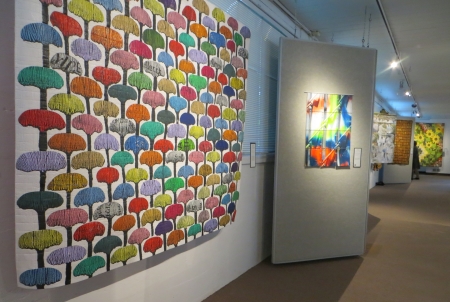
To the right of Hall’s piece is Susan Shie’s Dragon Sushi: 9 of Pyrex Cups in the Kitchen Tarot, with Rachel Brumer’s Large Regional Still Lives visible to the right.
May 27 13 004 small
This is another view of Polansky and Schwalb’s pieces in the distance, with Mary Rowan Quinn’s High Expectations in the center. Sandy Gregg’s Listen to the Rhythm of the Falling Rain is on the far right.
May 27 13 005 small
In the very back corner is Bonnie Peterson’s Kora (Pilgrimage), with Dale Preston Barry’s Yellow Ladder to the right. My quilt Spread Out on the Pavement is next and Sara Impey’s Bitter Pills is the next to the right. On the far right is Linda Levin’s Central Park West Sunrise.
May 27 13 006 small
This picture shows the very rightmost side of Sidnee Snell’s Riveted on the left, followed by the right side of Marianne R. Williamson’s Hidden Falls. On the far right is Miriam Nathan-Roberts’ Salt & Pepper, followed by Patty Hawkins’ Sunlit Canyon. You can see in this picture how long the building is.
May 27 13 087 small
This is Lisa Kijak’s El Cortez, Las Vegas, with Cynthia Corbin’s Threadbare to the right.
May 27 13 008 small
Rita Merten’s Plastic Trees #5, Olive Grove in Ampolla, Spain, is to the left, with Kerby C. Smith’s Graffiti Series: Chain Link on the right.
May 27 13 010 small
I think that’s Denise Linet’s Letters to Myself–Page 4 on the far left, with Linda Colsh’s Defiant in the far back. Colsh was one of the jurors, and she talked about calligraphic marks and big strokes, which are apparent in her piece. Beatrice Lanter’s Blossoms is in the foreground. Behind it to the right are Karen Tunnell’s Bubbles and Carol WatkinsVintage. Peggy Brown’s Soliloquy II peaks out on the right. Brown talked about fusing paper onto fabric, then painting over it.
May 27 13 011 small
Another view of Polansky’s piece is behind Dinah Sargeant’s Old Child, facing Susan Shie’s Dragon Sushi: 9 of Pyrex Cups in the Kitchen Tarot.
May 27 13 095 small
From here, I have shots of some of the quilts…I can never really explain what catches my eye, but know that it changed throughout the weekend.

This is Susan Shie’s Dragon Sushi: 9 of Pyrex Cups in the Kitchen Tarot. You could stare for hours at this piece and still have something to look at later. Shie always does a good job of documenting her pieces on her website (above), so I suggest you read her story. She did a series of drawings about a trip she took to Spain in 2012. This piece has many of the adventures and stories about her trip.
May 27 13 004crop
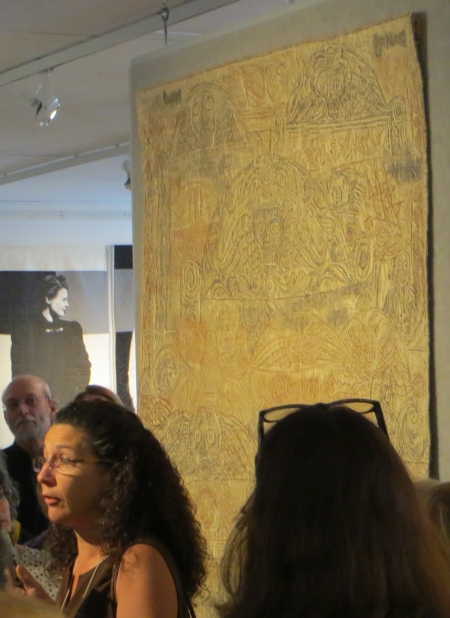
Next is Lorie McCown’s piece My Grandmother’s Dresses. Someone was talking to me when McCown was talking, so all I had typed into my phone was “Frida Kahlo.” I walked over and looked at her quilt again and blanked. Luckily, Lorie is an online friend and she saved me by sending me a short explanation. She had been reading Frida’s biography and wanted to base her work on a personal, biographical level…she called it “digging the well,” which she claims I do as well. Although I’ve never called it that, it’s true that a lot of what I draw is personal. She used her granny’s old clothing and embroidery and handwork to refer back to how she started in sewing…which is how I started too. The simple forms of the dresses repeated throughout is a nice contrast to the textures in the fabrics themselves; there’s a detail in my next post that shows this a bit better.
May 27 13 013 small
This is a full picture of Laura Fogg’s Jammin’, which I described in the last post on the artists’ talks. You can see the circles that I think of as coffee cup marks even now that I can see the echo of the center of the guitars in her stitching.
May 27 13 014 small
This is most of Paula Kovarik’s Round and Round It Goes. My camera was being a nasty beast and refusing to let me see anything in the viewfinder, so this is the best I have…that said, the best way to see her piece is in the many detail shots (like on the endpapers of the catalog). The details are amazing (next post!). She started with a recycled tablecloth, and the goal was to make it pretty, like a doily, until you get up close. There is nasty bad stuff balanced by beauty, dead fish near the sun rising, wildlife abounding near oil derricks.
May 27 13 015 small
Dinah Sargeant’s Old Child is beautiful and subtle…I meant to ask her about how she gets the fabrics to look the way she wants…does she just throw dye around or is there a purpose? Does she dye for just that quilt? Silly me, I sat next to her for at least an hour Saturday night and forgot to ask her all the questions that were in my head while I was photographing it. I will just have to chase her down again. This is a series about the passage of time. Her dad is going to be 95, so these quilts are like stories, showing the circular recognition between parent and child…as I and my parents age, I can see those relationships in her work.
May 27 13 019 small
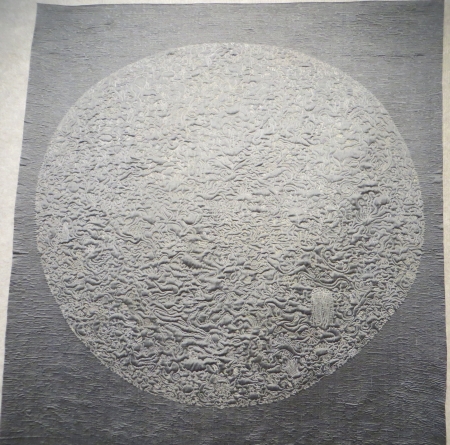
Brienne Elisabeth Brown’s Moonset is another very subtle piece from a distance. She says she is fascinated by moods and monsters, so when her husband interrupts her detailed stitching time, sometimes she sews his details into one of the monsters in her moon. She sews very slowly, which I think is the only way to put those creatures in her quilts. I have a detail coming up in a future post.
May 27 13 080 small
This is my own Spread Out on the Pavement. It seems dark in every photo…it IS a dark quilt, I guess. So my dad and some other viewer noticed a snake tongue between her legs…which I didn’t actually remember putting there. Remember that I did the original drawing (which is part of the quilt) in 2001…and then in 2012, I interpreted it in fabric. Looking at the drawing, I don’t know if I meant it to be the crease between calf and thigh or what…but when I chose the fabrics in 2012, I obviously went for snake tongue. Good catch, Dad.
May 27 13 082 small
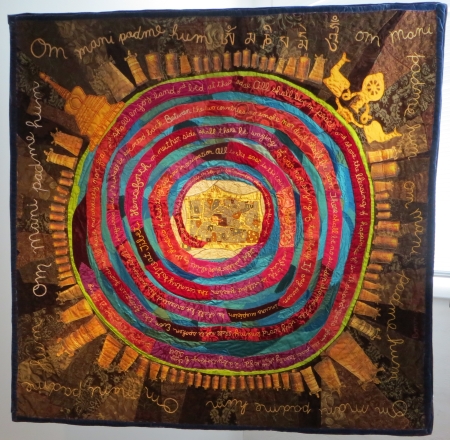
This is Bonnie Peterson’s Kora (Pilgrimage). She talked about a trip to Beijing the year before the Olympics and issues with the Chinese government and Tibet. She used monks’ sayings and Tibetan prayer wheels in her piece to represent treaties between China and Tibet. The piece refers to some of the Tibetan rituals.
May 27 13 083 small
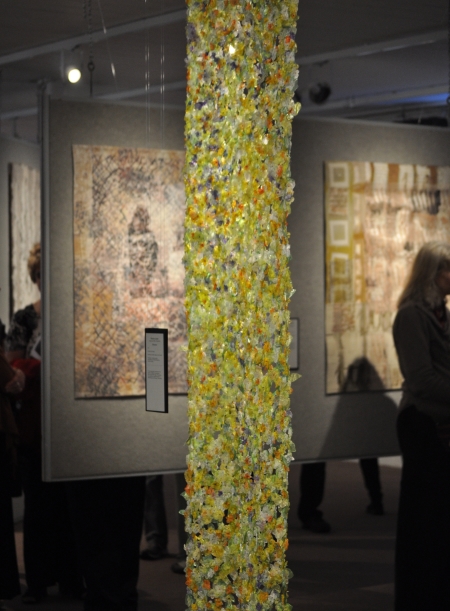
Dianne Firth’s Storm was amazing in that it is largely transparent and creates an interesting shadow on the wall behind. She is a landscape architect by trade and likes the idea of minimalist ideas capturing the ephemeral, passing moments. She used transparent materials to show the movements of air and the turmoil of storm effects. She was trying to show the angry nature of air changes in a storm…but also play with the idea that we can’t see air; we can only see the markers of air movement.
May 27 13 085 small
Shin-hee Chin’s Florence Nightingale was a differently constructed piece, reminding me of the crocheted circular rugs that my grandfather used to crochet.
May 27 13 086 small
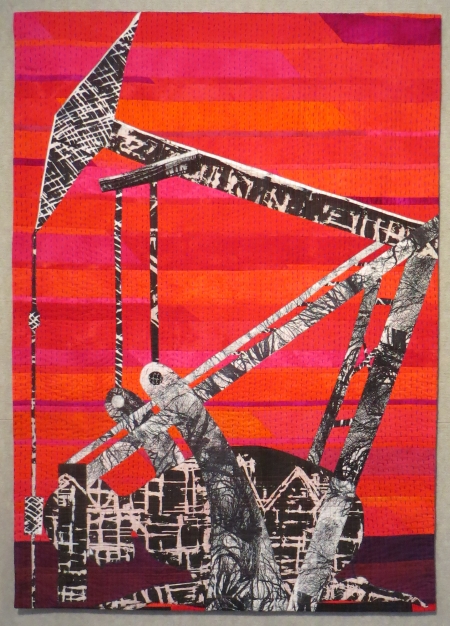
Elizabeth Barton’s Legacy shows her grandson holding the oil derrick on his back. There were many quilts related to the environment in this exhibit. The idea of resting our oil greed on the backs of our children and grandchildren is certainly one of our legacies.
May 27 13 089 small
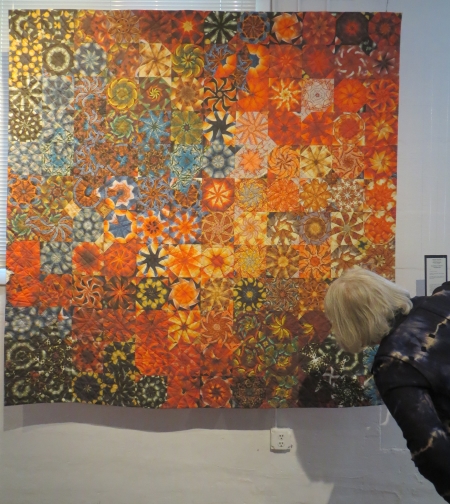
You can see the traditional roots in Eleanor McCain and Kevin Womack’s Swaddling to Shroud–Birthing Bed. Stay tuned for a detail in the next post that will enlighten you as to why that viewer is so close to the quilt.
May 27 13 091 small
Anne Smith’s Gabriel really is a colorful and playful quilt, especially with the pink tennies hanging down off the bottom of Angel Gabriel’s feet.
May 27 13 094 small
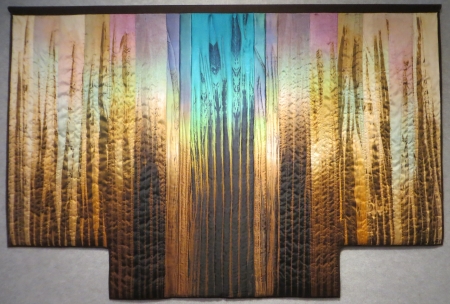
Judith Content’s Cenote Azul was stunning. Content was another one of the jurors; her pieces always have a sense of peace and beauty that glows from within. She talked about being inspired by nature’s waterways, especially coastal waterways in Northern California, but that this piece was based on a freshwater marsh on the Rio Grande right before a monsoon hit.
May 27 13 115 small
A side view of Barbara Schneider’s Forest Floor, var. 2. shows you some of the 3D aspects of this piece.
May 27 13 118 small
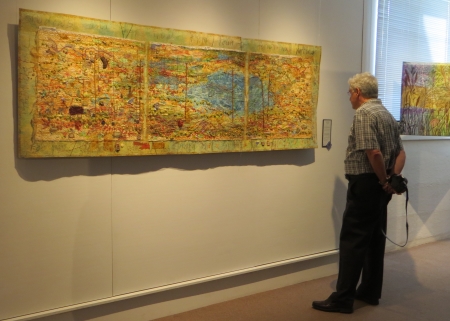
Brooke Atherton’s SpringField won Best of Show and was an amazing piece of work. The details were mind-boggling. She talked about journaling, saying that everything on the quilt was there for a reason. She called them icons and said if you touched one, it told a story, and all those stories were woven together into a larger story.
May 27 13 138 small
My mom captured Kate Sturman Gorman talking about Bernadette in Artichokes. She emphasized the importance of family history, stating that the world is made up of stories, not patterns. This is her aunt and it shows the migration from the old world to the new world. The plants in the foreground are actually thistles, but she liked artichokes better.
DSC_0316 small
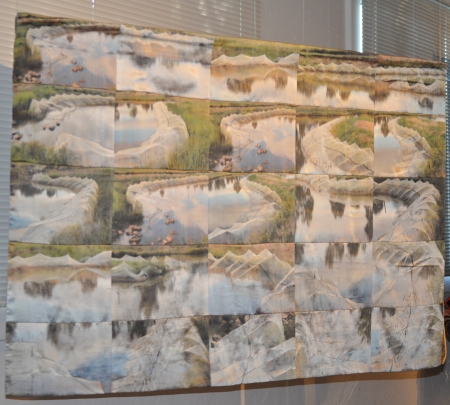
Susan Elizabeth Cunningham’s NetWork 1 is digitally printed photos of a Christo installation.
DSC_0284 small
This is another view of Lanter’s Blossoms with Linet’s piece on the right and Christine Chester’s piece Layers of Memory on the left.
DSC_0279 small
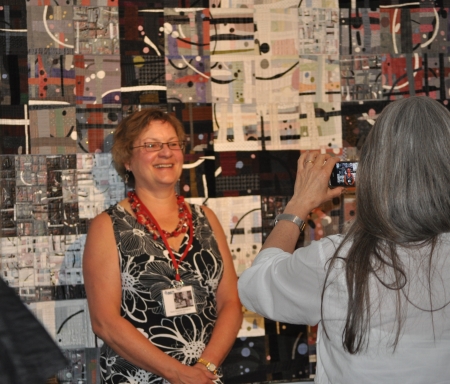
My mom captured Katie Pasquini Masopust in front of her piece Dolente (Sorrowfully).
DSC_0271 small
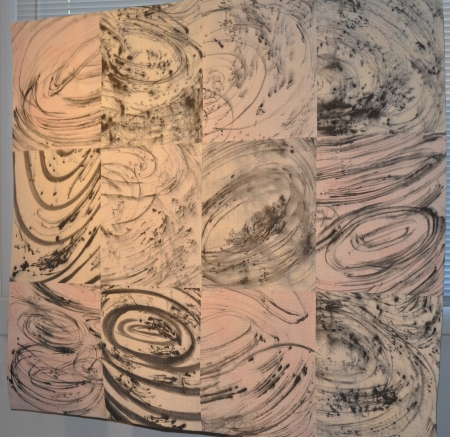
This is Carol Goossens’ piece As Summer Slowly Fades…
DSC_0250 small
Judy Hooworth’s piece Creek Drawing #8 mimics the movements of water with very simple line movement.
DSC_0200 small
Pamela Allen’s My Town by the River is different than most of her portrait pieces…strangely calm.
DSC_0199 small
Judith Plotner’s Urban Melody shows her continuing work with graffiti, which she photographs and then plays with in Photoshop. She screenprints parts of it and then uses raw canvas and paint to complete her pieces, leaving edges raw. I thought it was interesting that she talked about living off the grid far away from the city, but all her recent work is city-based.
DSC_0162 small
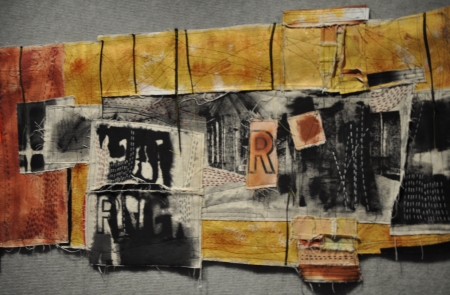
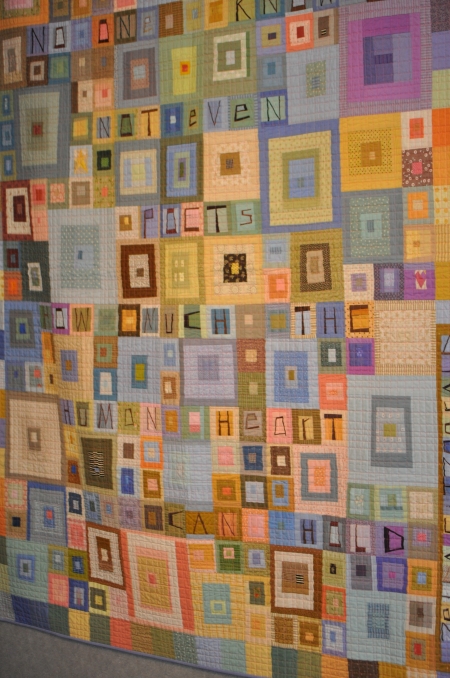
Molly Allen’s No One Knows Not Even Poets How Much the Human Heart Can Hold –Zelda Fitzgerald is a different piece. The title is included, pieced into the quilt.
DSC_0154 small
This is Sidnee Snell’s Riveting about the bridge she is apparently obsessed with. A friend and I compared Snell’s piece to another photo-derived piece…hers glows with depth and light that can only be achieved by multiple layers of cloth and stitching.
DSC_0142 small
Miriam Nathan-Roberts’ Salt & Pepper did start out as a photograph, but she wrote in the catalog about how important it is to her that she significantly alters the digital image with her hand, her stitching. She did well with portraying so many layers of glass and shiny metal in fabric, always a difficult prospect.
DSC_0139 small

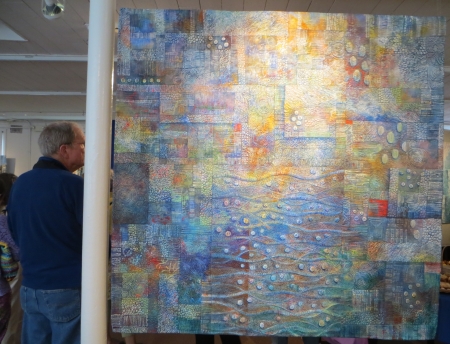
Here is Deidre Adam’s piece Tracings III, with my dad standing next to it. I’ve watched video of how Adams creates her pieces with paint and texture, and they are even more amazing in real life. Photographs just don’t show the glow and texture coming off the real thing.
May 27 13 051 small
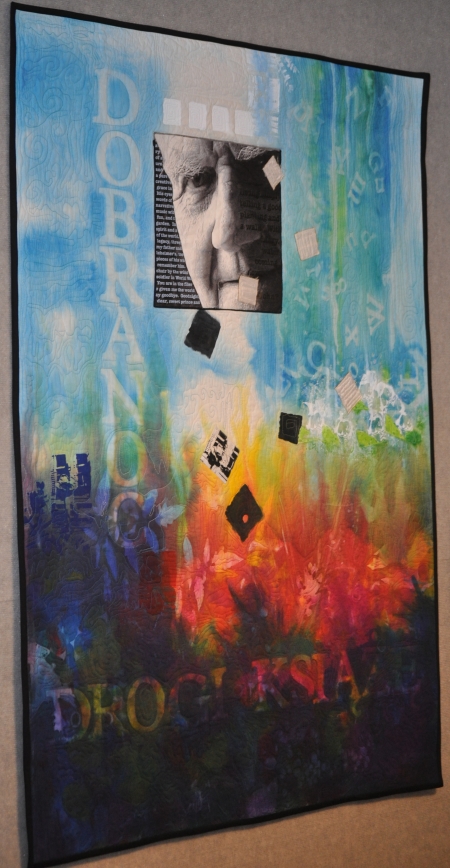
Here is a good shot of Marian Zielinski’s Goodnight, Sweet Prince, a fitting tribute to her dad.
DSC_0093 small

I have another post of detail shots that I’m working on…it may in fact take me another three days. I’m a wordy beast.

On Saturday afternoon, I attended the SAQA conference upstairs in the Dairy Barn, but that will need to be another post as well, or I will never finish this. Saturday evening was a pizza dinner in the same room…I can’t remember if that was a SAQA thing or an artist thing or what, but that was some of the best part, talking to other artists about their art.

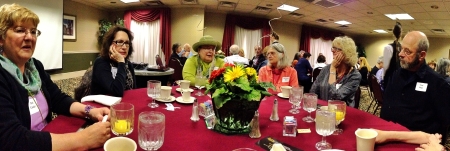
On Sunday morning, I went to the Friends of Fiber Art breakfast. My table mates included Deb Cashatt of Pixeladies fame on the left; Beth Smith from Visions Art Museum (we followed each other back home via Phoenix); the infamous Del Thomas, whose blog I’ve read for years; Marianne Burr; Karen Rips; and her husband Ted.
FOFBfast small

We had some interesting conversations about art, glass, blogging, and taking photographs while driving…like you do.

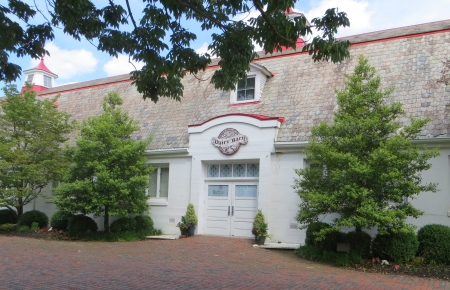
The Dairy Barn itself is an old dairy barn…shocking, I know.
May 27 13 100 small
This is a side view, with the Ohio quilt block on the barn.
May 27 13 099 small
This is the view as you drive up to the space.
May 27 13 098 small
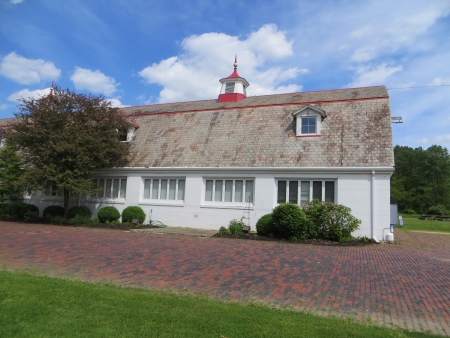
Here is another view, with beautiful Ohio skies in the background.
May 27 13 097 small
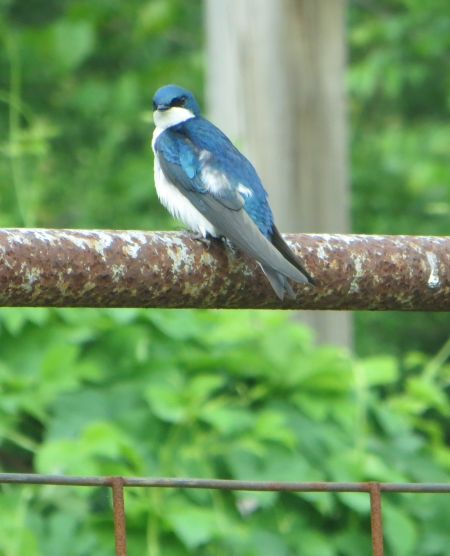
This pretty bird was hanging out in the parking area, right outside a small herb garden.
May 27 13 107 small
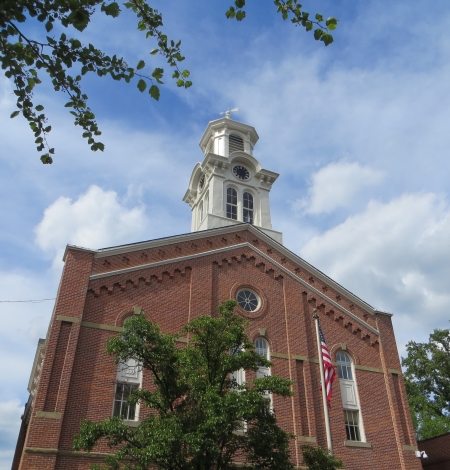
We did make one short trip into Athens for caffeine and sugar. Here is my photo of a random building in Athens.
May 27 13 102 small

We are obviously not in Earthquake Country…that building is made of bricks!

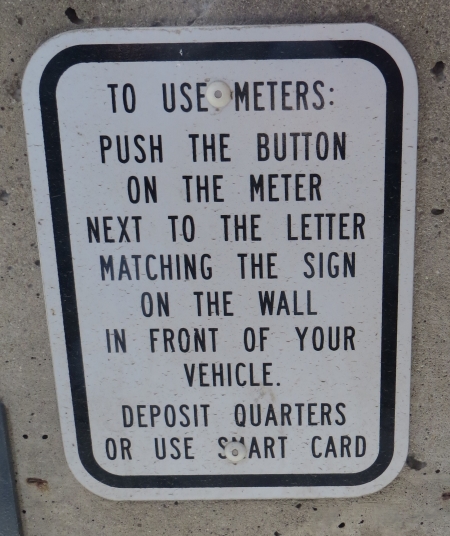
This long-winded sign made me laugh.
May 27 13 101 small

Sometimes I have to write directions like this on my tests for matching sections, so kids know what to do…it seems there must be an easier way. I know California prefers short, incomprehensible signs, which are also fun to photograph.

My next and last Quilt National post is all about the details, my favorite part.

Quilt National 2013: The Artist Talks

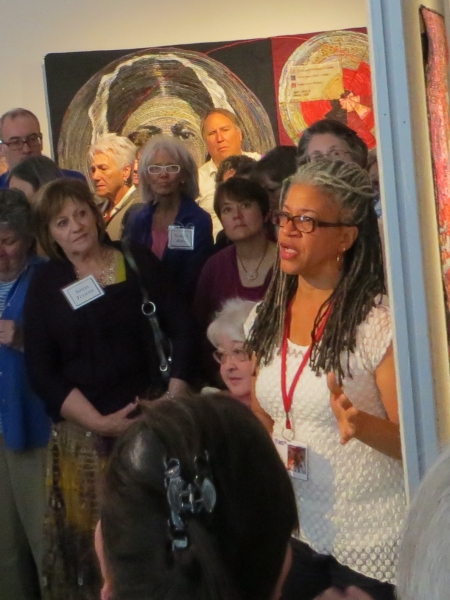
I suspect someone out there, like that one woman with the iPad who is in a lot of my photos of the artist talks, is going to post short, 2-minute videos of each of us talking about our art. Someone let me know when she does. I wasn’t that organized. I did take notes as people talked, and I tried to take photos of each artist with their piece, but the place was really crowded and I’m really short so I missed a bunch. Or I got just the top of their forehead. Needless to say, none of us looks awesome when we’re talking, except for maybe Elizabeth Barton (see below). Artist talks are always my favorite parts of any exhibit. I like to hear what they think, even when it’s just technique rather than inspiration. If I didn’t have a photo of the artist talking, I’ll talk about their inspirations/techniques when I post pictures of the exhibit later this week. For now, this is what’s intriguing me…people talking about their work.
I should also admit that I have barely looked at the catalog, let alone read statements yet. I’m saving that for when my head is less busy. I suggest you buy the catalog for the really good photography (unlike mine) and the official statements. I’m all about supporting art quilt endeavors.

This is John Lefelhocz‘s piece Mona in the Era of Social Butterflies.

May 27 13 021 small

When you look at this piece up close, you can see text in each box. John talked about the concept of a social butterfly and starting a dialogue, but the most amusing thing he said was “What would Mona Lisa say on her Facebook page?” I’ve seen a couple of parodies of famous artists dissing each other on FB. It’s an interesting take on the classics talking to the modern world. What is it to be a social butterfly these days? Is it the woman with 1000 FB friends that she’s never met?

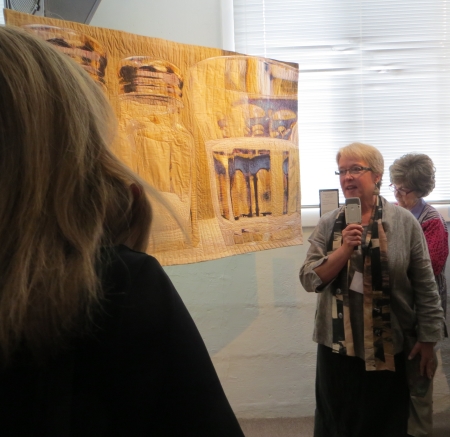
Charlotte Ziebarth talks about her piece Reverberations: Yellowstone Waters.

May 27 13 023 small

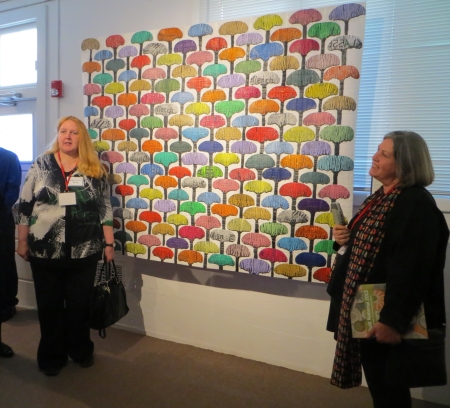
Charlotte won the Persistence Pays Award, with 9 entries over the last 16 years. I don’t remember how many times I’ve entered, but it wasn’t that many. She has some good background information on how she made this quilt on her website, on the right under Recent Posts. She is very interested in the patterns that water makes and using altered photographs. This is part of a continuing series and shows a dichotomy between hot and cold, using the geyser basins. What I find interesting about this piece is that it reads completely differently if you stand far away from it than up close.

Karen Rips is standing waiting for that funny-looking recording device we all had to talk into…the weird rainbow reflection on the top right of her quilt is not there in real life. Remember how I said my viewfinder wasn’t working? Yeah. Well, it wasn’t. Karen’s piece is called High Water Mark and is one of a series of three about the tides and how the body and emotions are related to tidal movements.

May 27 13 024 small

This is a very subtle piece and photographs don’t do it justice. There is a lot of detailed stitching in the black areas.

Cris Fee does a lot of drawing of live models, and sometimes self portraits, because she is an easy model to us. This is her piece Contemplating Self.

May 27 13 025 small

She likes to catch her drawing style in the quilt work. Everything is held in place with thread and paint.

Karen Tunnell does a lot of marbling on fabric. In this piece, Bubbles, she was trying to make the bubbles look like were sticking up off the fabric, using oil paint sticks and freezer-paper stencils, as well as trapunto techniques to achieve her goal.

May 27 13 026 small

It’s quite beautiful in person.

This picture amuses me. It’s Pamela Allen. I love her work. Is her work in the photo? Barely. Her piece is called My Town by the River and is very different from her brightly colored portraits with all their embellishments and stitching.

May 27 13 027 small

She explained that she had given her students an assignment to use toned-down, greyed fabrics, so she needed to do one herself. She has been working on a series of quilts of her home town. Her best quote? “I’m known for wonky.”

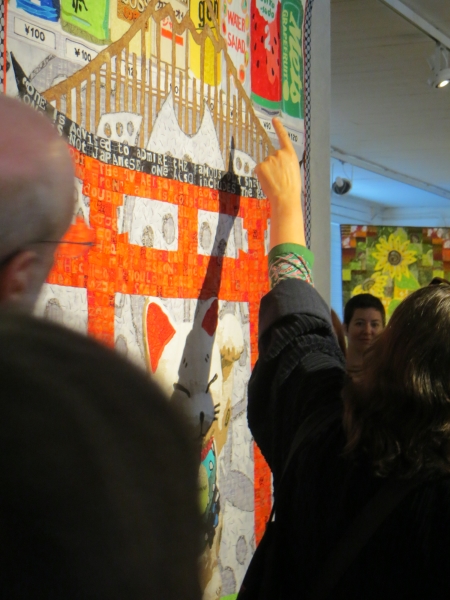
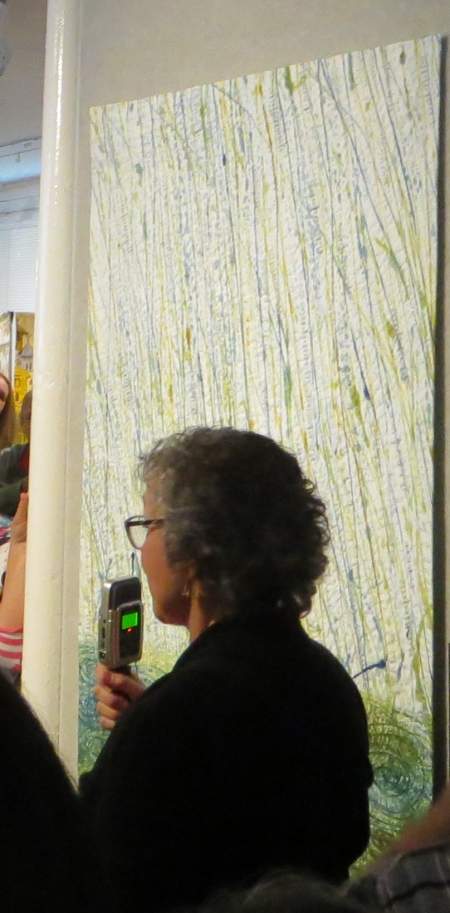
I missed pictures of Peggy Brown, Linda Colsh, and Susan Polanski, so next was Robin Schwalb, whose arm you see below pointing to Jive Boss Sweat.

May 27 13 029 small

Robin talked about putting pieces together from a bunch of cool places she’d been in Japan, including the beckoning cat, maneki-neko. The quote is basically that the native Japanese see differently than the tourists.

I missed photos of Kate Sturman Gorman and Dinah Sargeant, although I have pictures of their work that I will post later this week, and Susan Shie and Paula Kovarik as well. I don’t know how I missed so many…there were lots of people.  I did take notes, so I know I heard them…I just couldn’t see them.

This is Mary Ann Tipple‘s piece The Conversation, between her mom and her dad. She joked that this was the second time her dad had been in Quilt National.

May 27 13 030 small

There was some interesting discussion about Spoonflower and other digital printing services, which I’ll ramble on about at a later date. She did use Spoonflower for the large prints.

This is Carol Goossens piece As Summer Slowly Fades. I was very intrigued by the coloring in this piece. Carol said she had a few months off of work and wanted to do a piece about summer turning into winter. She had started with machine stitching, but wasn’t getting a strong enough line, so she ended up hand-embroidering on it instead. It bugged her that she only had male birds in the piece, but the females weren’t going to show up…then she read that red-winged blackbirds congregate by gender in the fall, so she was happy to keep them all together in the quilt.

May 27 13 031 small

I’m certain I have a detail of this somewhere, but that will have to wait.

Elin Noble‘s piece Fugitive Pieces 11 is beautiful in person, and the detail in the catalog shows some of the specifics of that. She talked about emotions, memory, and grief, relating to the Canadian poet Anne Michael’s novel Fugitive Pieces and all the motions one goes through in life. Her love is for dye and fabric and thread…she even dyes the thread, but emphasized that she doesn’t dye the threads she uses on the back…that would be a waste, wouldn’t it? Unless you put the stuff you didn’t like on the back…

May 27 13 032 small

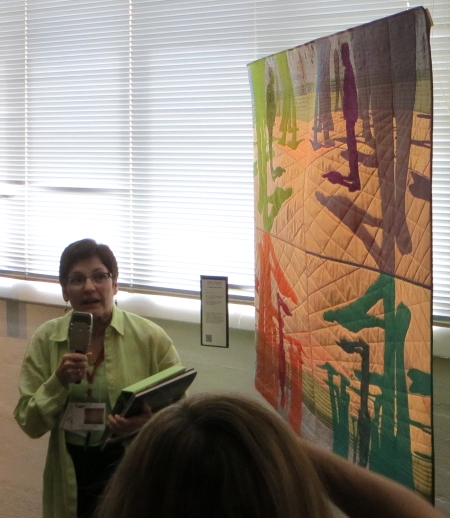
Across from Elin’s piece was Katherine Knauer‘s Solar City. Katherine has been doing a series on earth, air, fire, and water, and she liked the idea of a whole city running on solar power. She used a digital printing service to make fabrics with a variety of electrical symbols, referring to renewable energy; the sunflowers are made up of taxis, presumably running on renewable energy of some sort.
May 27 13 033 small

Nelda Warkentin‘s piece Bella Woods refers to the cycle of birth, life, and death found in the woods. She likes not just the standing trees, but those that are falling down. She uses the geometry of the line of trees to depict what we have in life, referring again to evolution and rebirth.

May 27 13 035 small

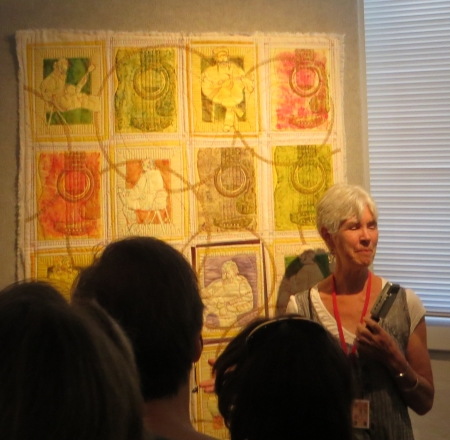
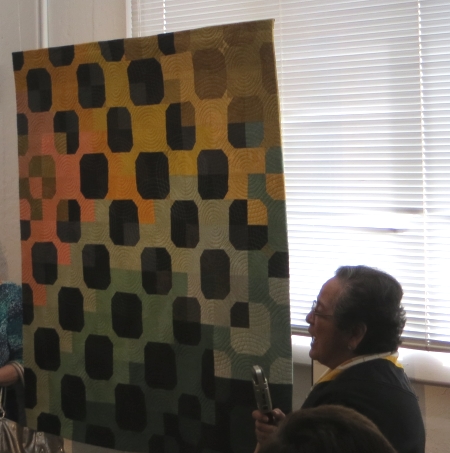
Laura Fogg may be known for her landscapes, so this piece Jammin’ is a departure from those. She drew some musicians freehand with her sewing machine and that turned into a quilt. I think the printed circles look like coffee cup stains, which makes sense to me in this quilt.
May 27 13 036 small

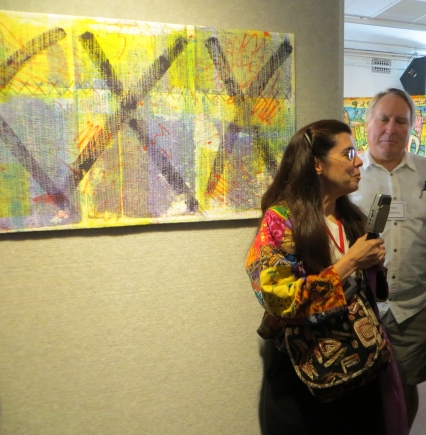
Cathy Kleeman‘s piece Post No Bills wasn’t working for her. She stitched it, painted on it, got stumped by the piece, and painted big black X’s on it to show it who’s boss.

May 27 13 037 small

Sandy Gregg was talking about her piece Listen to the Rhythm of the Falling Rain while someone else was talking to me (this might be my excuse for everything!), so I missed the first part, but I do remember her saying that she painted individual raindrops and added text to the bottom where the rain fell. I suspect I’m hiding a detail shot of this somewhere on this computer for later use.

May 27 13 038 small

Too bad I wasn’t on the other side to get a shot of her face.

I missed Lorie McCown‘s explanation, although for some reason I typed Frida Kahlo into my phone. I have a picture for later…her piece was very cool. I wish I knew why I typed that. I could ask her!

Susan Brooks talked about being commissioned to do a 9/11 quilt, but the fabric they made was ugly, so they each took a piece to do something with it. Her something included ripping it to shreds and putting it back together in this format, which made her think of her art group and the strength it gave her. This is Together.

May 27 13 039 small

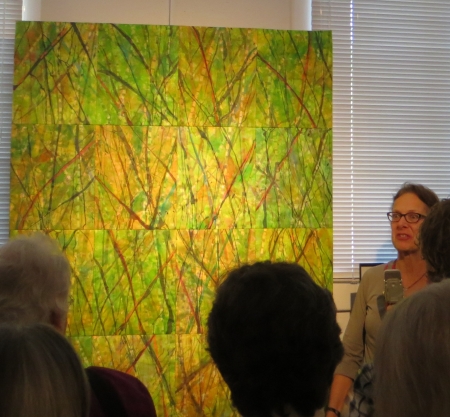
Barbara Schneider‘s realistic leaves in Forest Floor, var. 2 are very impressively dimensional. She wanted to show things that were impermanent or decaying, but still beautiful, quoting wabi-sabi. There are about 100 maple leaves that were scanned, printed, stitched, stiffened, and shaped. The quilt is made in 4 sections and show distinct areas of light and shadow interacting.

May 27 13 040 small

I have a totally awesome picture of the artist there too, eh? I am short. What can I say?

This is Susan Lenz‘s Circular Churchyard, an amazing piece of grave rubbings from an historic churchyard in Charleston, South Carolina. The rubbings were done with permission in a graveyard that normally doesn’t allow this, over Halloween weekend…one wonders if any ghosts travel with the quilt. She talked about the ethereal nature of our lives and the passage of time through generations.

May 27 13 042 small

This is the first time I’ve met Susan, although I’ve emailed her with the I’m Not Crazy exhibit and I own one of her auction pieces. I love the work she does, and this piece is truly gorgeous in person.

Kerby Smith waits to talk about his piece Graffiti Series: Chain Link. This is an awful picture of it. Kerby announced himself as the photographer who quilts, and referred to tradition being tied with nontradition, as well as speaking about his focus on color and design. The pieces are linked together with large loops, like in a chain.

May 27 13 043 small

The next artist, Rita Merten (on the right), had Brigitte Kopp speak in English for her about Plastic Trees #5, Olive Grove in Ampolla, Spain. She recycled plastic bags for this piece, liking the idea of bringing the materials back to nature and making them into trees.

May 27 13 046 small

This is a very stunning graphic piece in person.

Lura Schwarz Smith‘s piece Passage refers to her mother’s declining memory. The drawing began on paper and includes digitally printed fabric.

May 27 13 047 small

You can see I wasn’t the only person trying to take photos.

I tried to get a decent picture of Sheila Frampton-Cooper and her piece From a Seed, which was inspired by one of her small watercolors.

May 27 13 048 small

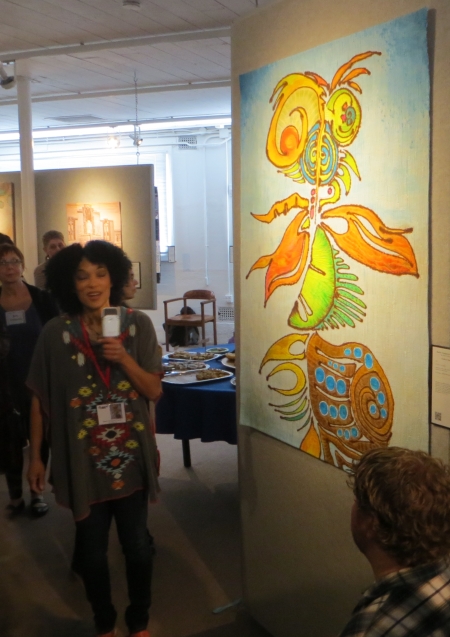
I tried. She is an active talker…she did this as a whole-cloth painting with Procion thickened dyes and some paint sticks, but it’s the quilting that makes this piece. I’m sure I have a detail for later. She called this a subconscious drawing, and talked about trying to get the feeling of rain in the background, referring back to a seed growing into a funky plant.

I told you she was an active talker…

May 27 13 049 small

I missed Eleanor McCain talking about her collaborative piece Swaddling to Shroud–Birthing Bed with Kevin Womack. But here is Kevin talking about it…

May 27 13 052 small

The two talked about referencing traditional bed quilts, yet talking about what might happen IN or ON the bed, such as birth. There are digitally printed fabrics in the quilt, which is pieced from a variety of photographs of babies and prints of reproductive systems, as well as other things. Yes, I have a detail…later. I might be here for days on this one post if I don’t keep going.

Sandra van Velzen‘s quilt Behind the Facades is about Amsterdam’s canals and houses, what is behind the facades, referring to darker paintings from the era of famous Dutch art in the 17th century. This is a 3-dimensional piece, pushing out from the wall.

May 27 13 053 small

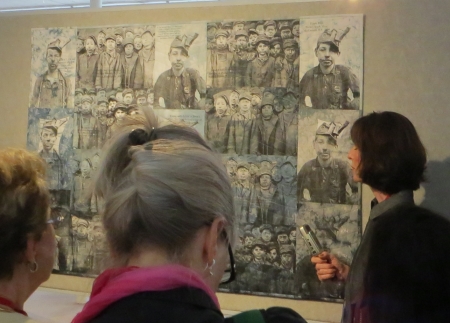
Patricia Kennedy-Zafred‘s piece about children and mining history is named Descent into Darkness: The Boys of the Mines. She uses historical images to tell the story. She won The Heartland Award for this piece.

May 27 13 054 small

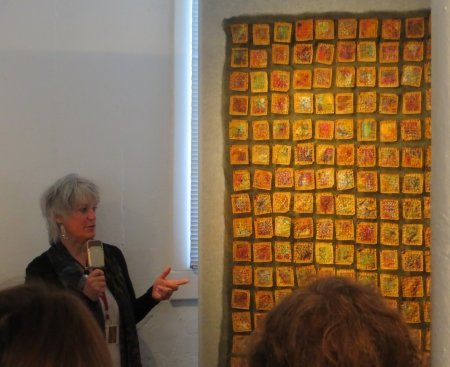
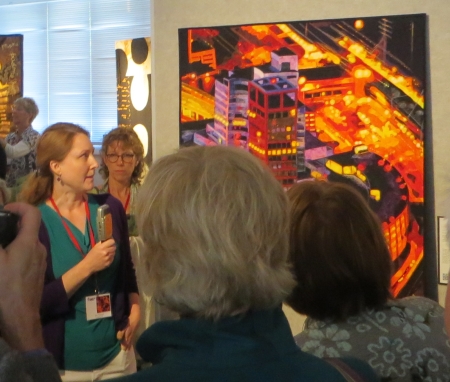
At this point, I talked about my own quilt, and then got trapped down there for Lisa Kijak‘s commentary about her drop-dead beautiful piece El Cortez, Las Vegas. You can just see Sara Impey‘s Bitter Pills on the left side of the photo and Lisa Way Down There. Lisa’s recent work all draws from neon signs, showing the texture and passage of time. For this piece, she went to a neon graveyard (a cool idea in itself). She comes from a printmaking background (gee, I don’t know anything about that), so the positive and negative spaces have a different kind of importance. She uses thousands of pieces in each quilt, and if you go to her blog, she’ll tell you about one fabric in this quilt that was difficult to find. She also uses only commercial fabrics and tulle to help shade colors. I have details of this quilt for later.

May 27 13 055 small

I missed pictures of Kathleen McCabe, Judith Plotner, and Judith Content, and my photo of Kris Kasaki and Deb Cashatt dancing around with their microphones was amazingly bad, but their comment that they met 50 pounds…each…ago was amusing.

Pam Rubert‘s piece Seattle–Wish You Were Hair, referencing the Space Needle, is part of her vacation postcard series, if you think of those cards that say “Wish you were here,” but realize Pam is into bad puns. She uses world monuments to make really bad hairstyles, but showing that each place has an individuality to it that’s important. She mentioned that things are becoming the same everywhere, so looking for the individuality of a particular place is important…hence the buildings shaped like spools to match the needle.

May 27 13 060 small

Here is Pam herself talking about her quilt…

I didn’t expect her voice to sound like that, but I always have that problem…we imagine artists to look and sound a certain way (who knows why) and we are usually wrong.

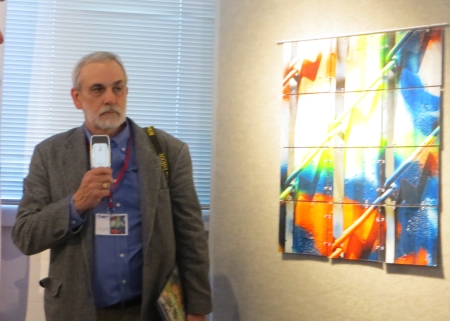
Kathy Weaver was another artist I had imagined wrong (I should stop imagining people, eh?)…this is her piece Biomechatronics Development Lab 2 v 2, based on a series of charcoal drawings of robotic arms made for soldiers losing limbs in war, as well as other people. She transferred her sketch onto fabric using a digital printing company, then airbrushed and embroidered over that. She liked the idea of using a classical drawing style to depict modern robotic devices.

May 27 13 063 small

This piece by Marian Zielinski, Goodnight, Sweet Prince, is a farewell piece to her father. She spoke quite emotionally about making the piece. The photos she used were taken as he was diagnosed with the illness that killed him. She commemorates his life by telling her story of her father. She liked the idea of using elemental energies to make the quilt: the sun for printing, the pigment for earth and water, dried by the air.

May 27 13 064 small

Marianne Williamson based her piece Hidden Falls on a waterfall in a cavern where there are no lights, the air sounds muffled, but water is falling. There is a timeless quality to the piece, as she imagined how the rock face might look as it is dislodged by the water and falling to the bottom, how water splashes and hits the pool below.

May 27 13 065 small

Susan Callahan’s piece 2 Top is based on her obsession with food and with setting the table before the people show up.

May 27 13 066 small

Kate Themel talked about the influence of light in her piece Morgan’s Flight. Morgan is the pilot who flew over the town in the quilt and provided her with reference photos for the quilt. She was trying to work with ideas of multiple sources of light or what if buildings were lit from inside.

May 27 13 067 small

I listened to Arle Sklar-Weinstein, Leslie Bixel, Bonnie Peterson, and Dianne Firth, but got no decent photos. I’ll talk more about their pieces in a later post. I do love Elizabeth Barton‘s piece Legacy and her face while talking about it. I don’t remember why it made her laugh. She started this piece about the environment in a smaller quilt, but used a picture of her grandson for the bottom section, supporting the oil derrick, which is much easier to see from far away (and doesn’t even show up in this photo). I think she was laughing because she had called her daughter and told her to drag the boy out of bed and put him in a particular position (what artist hasn’t done this?) and photograph him for this, and yes, she needed it right away. I think I have a full photo of this one for later too.

May 27 13 069 small

I missed Brigitte Kopp…or more accurately, I have a picture of the top of her head and even that is blurry.

This is Sidnee Snell standing in front of her piece Riveted, which is not even in the photograph. She talked about an infatuation with a steel bridge in Portland or nearby and all the photographs she’d taken of how the wind and rain had interacted with the paint. It’s a beautiful piece.

May 27 13 071 small

Miriam Nathan-Roberts was unable to come to the opening due to serious illness, so Judith Content talked about this quilt, Salt & Pepper. Content had to recuse herself from the jurying on this piece, because she had watched her friend take a very long time during her illness to finish this quilt, how she would take breaks for weeks and then come back to the piece.

May 27 13 072 small

Cynthia Friedman is working with symmetry in her piece A Man among Giants. She was interested in the shapes of people and bodies and the shadows they make. Her quilts are often block-based and reflecting, but the blocks can be placed together in many ways for a different look. She uses a computer to mess with the photos and draws from there, using the computer to test symmetrical layouts.

May 27 13 073 small

Silvia Gegaregian started her quilt Bow Tie when she found some fabrics because she had to clean out her studio to remove the carpet. The fabrics spoke to her. She told the story that her husband doesn’t like this quilt and would say to her “You’re still working on that one?”, surprised that she continued to work on something he didn’t like.

May 27 13 075 small

This is Patty Hawkins‘ quilt Sunlit Canyon, based on the mountains she loves, trying to show the wear on the trees caused by elk and bear. She likes to play with the fabrics and uses deconstructed screenprints in her work.

May 27 13 076 small

I heard a few more people speak, but no photographs. I do have other photos of the pieces themselves, the gallery, and my favorite, detail shots, but you can only do so much in one blog post, and this is a LOOONNNGG one. I do like to document though, so you can blame it on that. The artist talk is always my favorite part, and I like to see what the artist looks and sounds like who makes the art, so that was worthwhile. Tune in later for more details on Quilt National 2013.

Mentally Processing Quilt National

Most of the artists and attendees from this year’s Quilt National are now home or on their way there (Del Thomas, I’m thinking of your 5 days to GET there). For the artists, I’ve seen lots of messages about trying to process the trip, or still floating in the air from the experience…many of us are trying to process photographs at the same time (long gone are the days when we dropped the film canister off and waited patiently, sometimes over a week, for the photos to be ready.), trying to get posts up of the experience, trying to process what we felt, what we thought, what we saw.

I have lots of photos, but I’m also very anal about labeling them with the correct name of artist and piece, and also linking it to the artist’s website or blog, if I can find one. That takes lots of time. It’s honestly time I don’t have right now. I missed two days of school last week and I have professional development off campus tomorrow. I was at school today for almost 2 hours, going through the pile of stuff the sub left me from last week, prepping for tomorrow’s sub, and then doing the science dishes. I needed to wash all the dissection equipment to get it ready for the frog dissections later this week, and I needed to wash all of the slide stuff from last week that didn’t get done before I left.

I came home and input grades, prepared a lesson plan for the frog dissection (which I’ve never done before), and got all the stuff together for the kids who won’t be doing the unit on human reproduction. I have ten tons of grading to do, as always, and the end of the school year brings a boatload of planning and activities and parent meetings.

I’m feeling incredibly overwhelmed.

That said, I’m also feeling inspired, as I’m sure many of the artists are. I spent the weekend looking at beautiful and amazing artwork and having long discussions with artists about their lives, their processes, and their artistic histories. I heard about techniques, materials, inspiration, and major life changes. Some artists were bubbly and excited, some were very technical, and some came to tears as they talked about their piece or their journey…or just their own feelings about being in the presence of the rest of us.

I find when I’m at an opening or a weekend full of events like this that I have a hard time even taking pictures. I did better this time, because I had multiple chances to come back in the space and take more pictures. I will probably find I wanted more than what I have, but in general, I think I did OK. The hardest part of the picture-taking is that my camera viewfinder is defective. I’ve known this for a while…it comes and goes. The viewfinder goes into this weird mode that is almost all black…you can just barely see things that are very light, and they are dark red on the viewfinder…so I can’t focus on anything or frame the picture properly. That might explain some of the photos when I post them (maybe tomorrow?). Yes, I should (1) get the camera fixed (time without a camera seems a problem) or (2) get a new camera (money is definitely a problem). Both are in my mind, especially after this weekend. It hasn’t done it in a while, so I’m not sure what prompts it. Removing the battery or card don’t seem to help. It’s not some funky setting…literally if you change the position of the camera, it might go back to being normal. It still takes normal pictures…you just have no idea what they might look like until later.

Did I mention all the great conversations I had? None of them were about my camera.

I’m also really tired right now. My body is not really adjusted to either Ohio time OR California time. It’s on sleepy time. Recovery time. Stress time.

So I will post photos with links and all those pretty things that people want to see…I just can’t handle it tonight. I have only been home for 24 hours. I have to go to school tomorrow (or at least to work, if not to my actual school…well, except we have a parent meeting, so I do have to go to school). And the tiredness just hit me upside the head…hard…like a wrecking ball.

I’m still mentally processing. Seeing the pictures come off my camera was exciting…but not exciting enough to keep me awake. More later…