Masters: Art Quilts, Volume 2 Giveaway
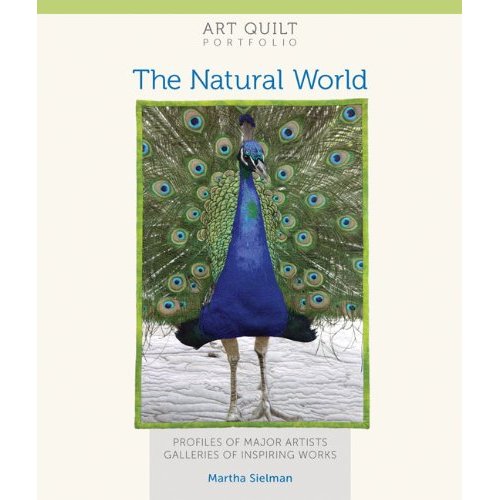
Back in August, I reviewed the second volume of Martha Sielman’s (and Lark Books’) Masters: Art Quilts, Volume 2. You can read it here, if you don’t remember all the pithy things I said. I focused mostly on the male quilters included in the book in August. Honestly, it’s hard to pick a few to focus on…each time I look at it, I like different artists. Today, for instance, I’m sorta fascinated with Karin Franzen’s birds. I saw some of her pieces at the La Conner Quilt Museum back in April 2009, and they are always more wonderful in person than photographed, but certainly that doesn’t stop me from studying her work in this book.
I had given Martha Sielman my name as being interested in reviewing the book, hopefully receiving a copy from Lark. As you might read back in July, I was too tempted by sitting at the SAQA table at IQF Long Beach to stop myself from buying the book, which is a good thing for you, because now I have an extra copy. I’ve had it all month, and wish I’d been organized enough to do this giveaway early enough so that someone could have had an extra holiday gift, but I was too busy to even deal with my credit card bill, so here we are…a New Year’s gift to you. Comment below and I’ll draw on January 1st and mail it off to you. (yes, I promise to remember to do this).
I emailed Lark this time and asked for some pictures…you know, like 20 of them. They thanked me for my interest and sent four. Hey, that’s four more than I had last time! So enjoy…
This is Emily Richardson’s After the Sea Ship (silk, acrylic paint, hand sewn)…
You can see quite a bit of her work at the Gross McCleaf Gallery. At the moment, that page just shows a bunch of empty boxes, but if you click on them, some fairly amazing photos of her work pop up…you can definitely see the hand-stitching and the luminosity of the silks and sheers. I’ve seen her work in person, and it is drop-dead gorgeous. I actually think this piece looks better in the book than it does in this picture.
I didn’t mention Gayle Fraas and Duncan Slade the last time I reviewed the book. I wasn’t sure I liked their pieces at first, but in retrospect, the combination of far-away landscapes or maps with a close-up of water seems to reflect the ultra-realism of the images combined with hand-stitching. Their technique and ability to work together seems seamless. They live near the water as well and it shows in their work.
Alice Beasley is another artist I didn’t mention, although I am interested in how she makes faces. She doesn’t flinch from prints in her portraits, and her work recently got her a spot in Quilt National’s current show, so I’m not the only noticing her work is intriguing and makes you look twice. I wish she would blog more often, but she does admit her issues with technology…there are plenty of us who have started blogging only to realize we don’t really want to talk to the world. I’d like to see Beasley’s work up close too, although this book does a fairly good job of showing me a variety of her work.
Risë Nagin is a long-known name in textile art, but her piece Gate keeps bugging me to go back and look at it again.
This site on American Art was the closest I could find to a website for her. You should go watch this great video of her design process, though…
I love listening to and reading about how artists make their work. The piece above is not a small one, by the way…it’s 70″ square.
I did mention Izabella Baykova in my previous review, and since seeing her work for the first time in the Masters volume, Martha Sielman also published a short article on her work in Quilting Arts, the October/November issue (which is somewhere in my house). The piece below is Little Night Serenade #13 Allegro.
I would love to see her work up close…it’s hard to imagine from the pictures what her techniques are…and of course, as another quilt artist, I want to know how she MAKES it. Actually, the images themselves are worth it to just see from afar, but I suspect the detail in windows of this piece are lost in the photographs. The book says she uses sheer silks and paint and embroidery to create her work…it must take many hours to make a piece like this one. Does she start with a drawing? Is there a photograph she uses? Is it all in her head? These are the things I want explained.
Linda MacDonald’s work is also in the Masters’ book…I’ve been intrigued by her work for years, mostly because I came from a screenprinting background and hers were the first quilts that incorporated what looked like a printmaking background in their style. She actually uses a freezer-paper pattern and airbrushes her pieces, but they have the black lines that remind me of lino printmaking. Her focus is environmental issues, so the cut stump of lost forests shows up often.
Dorothy Caldwell’s Bowl is smaller than it feels to me, being only 18″ square.
You can see a lot of her work here. In the Masters book, Sielman describes Caldwell as drawing many lines in the wax before printing, all those hatchmarks done by hand, very labor-intensive work. It seems the more time we spend on our work, the more it holds others’ attention. I wasn’t thrilled by Caldwell’s work before, but have gone back to look at it again and again, so it has obviously done its job well. The textures of the markmaking and the simple line of the bowl, so simple it doesn’t even connect properly, draws me back…and that blue polka-dotted fabric hanging from the side…is it in the bowl or outside? I really do like this piece after staring at it over and over again.
Simply put, the book is a treat to go back and view again and again…even the more geometric works, which generally don’t float my boat, some of them are growing on me, whether it’s the movement of colors or the shapes caused by the patterns. Collections like these are important to our turning the quilt-as-craft into quilt-as-art.
Now I can go back to my quiet house (kids at dad’s!) and finish cleaning the litter trays…my gift to the cats. It’s an exciting Xmas Eve here in the Nida household…remember to comment with a way for me to get a hold of you if you would like a copy of the Masters Volume 2 book.
Protected: Wasting Time?
I’m Not Crazy…An Exhibit, Not an Affirmation…
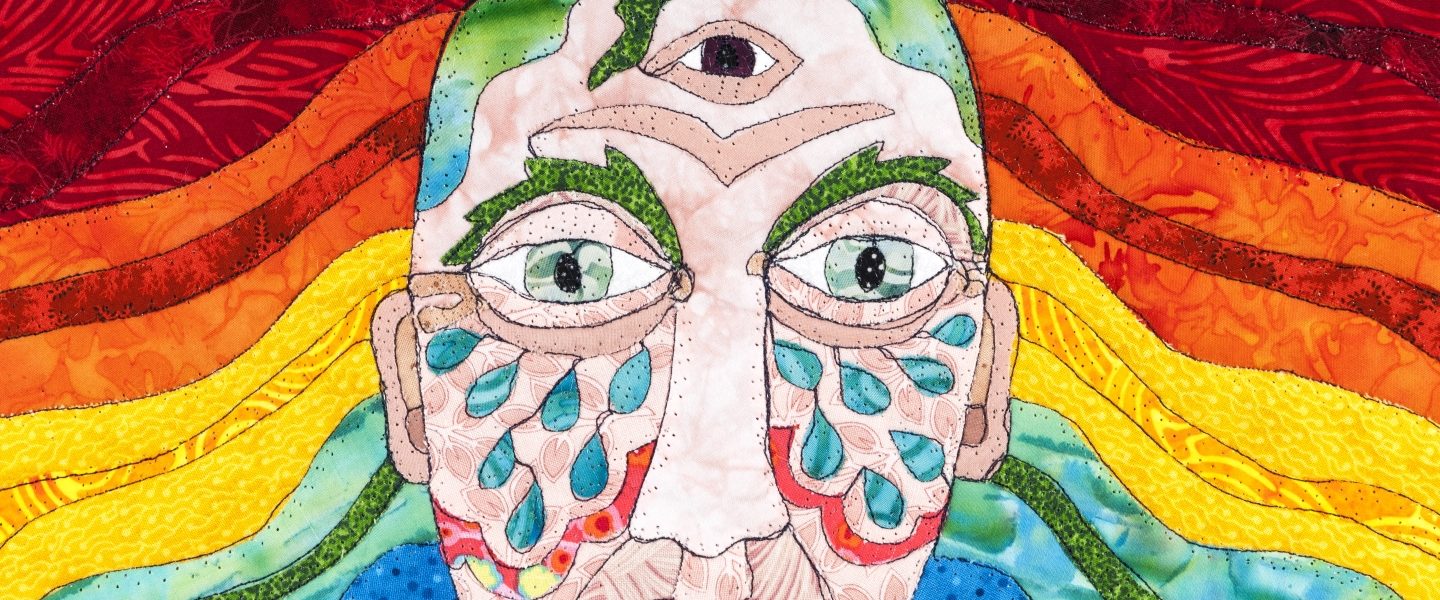
This is how busy I’ve been…I announced this on Facebook a week ago and haven’t had time to come over here and give what details I have. SAQA has a curator-in-training program that I tried to get into last year with my idea of an exhibit called Uncovered, focusing on the nude in textile art. The exhibit travels with the Mancuso quilt shows; in fact, the No Place to Call Home exhibit I was in last year that caused such a ruckus in Virginia was the first of these training exhibits. They were leery of the nudity and suggested I find a gallery venue (gee, I have those just lined up!) for the exhibit, and maybe someday I will. I applied again this year and was excited to learn last week that I was accepted into the program with this year’s attempt, I’m Not Crazy.
I can’t give full details yet, except that I’m the curator, not the juror (still working on that). The call for entries will officially go out in early January and entries will be due in the month of May, juried in June. The show will travel with all the Mancuso quilt shows for a year, which is very cool. Pieces need to be at least 20″ in width or height, no more than 50″ in width, and no more than 65″ in height. You do have to be a SAQA member to participate, but you don’t have to be in the United States.
Here is what I was thinking for the theme, based on some experiences with family members, friends, and friends’ family members who are all dealing with mental issues or the fallout from those issues…it’s pervasive.
Mental illness carries with it a stigma; many of us have experience with disorders, temporary or permanent, curable or not, that in the past and in some cultures even today would be labeled as crazy.
The stigma of mental illness can make it difficult to admit its effect on our loved ones or ourselves. Disorders as common as anxiety or depression, or less common, like schizophrenia or multiple personality disorder, can have a devastating effect on families and friends, and on ourselves. It might be temporary or even curable, or it might not be either. Negativity towards those who have these disorders often causes many people to keep the diagnosis hidden from friends and family.
- What does “crazy” look like?
- What does it feel like?
- How does the world look through the eyes of someone experiencing a panic attack or depression or other mental disorder?
- How does loving or caring for someone with a mental disorder look and feel?
I’m looking for work that covers these experiences: from the eyes of the caregiver, the friend, the family member, and, of course, those who have experienced any of these disorders themselves. It doesn’t have to be depressing…in my family, we deal with death and illness and crazy by making fun, laughing, finding other ways to get through it. Sometimes all you can do is make jokes, because you’ve spent too much time worrying.
Anyway, think about it. I’ll post links as the prospectus is ready to post.
I have to say that while I was coming up with this idea (it crept up on me), this song kept going through my head…
And it still is…