Elizabeth Barton: Inspired to Design

I was recently asked to review Elizabeth Barton’s new book Inspired to Design. I’ve been reading Barton’s blog for a long time, and have enjoyed her focus on looking at quilt art the same way we look at other types of art, with a critical eye for composition, balance, value, and color. So much quilt art ignores the fundamentals of good art. Her discussions make you think about what you’re making, why you’re making it, and how you can make it better by improving the viewer’s experience. In her introduction, she emphasizes making quilts that come from your own inspiration and voice, but that are still well-designed and planned. This book is great for the quilt artist who hasn’t done a lot of designing on their own, or who feels like they need some support or direction to make their quilts more successful on a regular basis. As she says, “After you’ve had a lot of experience with looking and designing…many of the steps and things you have to watch out for become more automatic.” Whenever someone complains about how easy I or any other artist makes it look, I remind them I’ve been practicing drawing for 40+ years and quilt art for 20+ years. It takes time and practice. Barton emphasizes this in her book, but also provides lots of assistance in how to complete the practice.

Inspired-to-Design-Cover-231x300

Barton teaches workshops, and believe it or not, just based on how impressed I am by her blog, I considered taking one of the online classes. She suggests there are 7 steps to successful art quilts.

In Step 1, Inspirations and Design Sketches, Barton helps artists figure out how to collect inspiration, and from there, move into designing techniques of cropping, rearranging, working with shapes, and repeating elements. There are many pictures of Barton’s work as examples and exercises to help you find your inspiration. Step 2–Size, Shape, and Structure–helps you decide how big to make a piece and how the structure of the piece’s design will affect the finished artwork’s effect. In Step 3, Depth and Space, Barton discusses making your 2-dimensional piece have depth, using a variety of techniques. She touches on perspective, as well, which can be an issue for those who never made it through art school (here is where I admit that I am an art major who never had to learn perspective).

barton

(Echoes in the Memory, one of Barton’s pieces that illustrates her use of color and value to move your eye from foreground to background)

Step 4, Value, discusses fabric dying, as well as making sure your piece has at least three levels of value. Value is also reviewed in Step 5, Color, making sure that the hues have lights, mediums, and darks. Barton uses color in amazing ways in her quilts, and this section covers all the types of color schemes, as well as providing some exercises for encouraging quilt artists to branch out and experiment with color. Step 6, Evaluating Designs, might be the most important section of the book. She suggests making many designs, so you can pick the best ones. She sets out steps for evaluating your work, making sure that your design is strong before you start messing with fabric, and reminding us to have a good reason for ignoring any of the principles of successful design. It’s OK to break the rules, as long as you are aware of them in the first place.

cement works 300[3]

(Cement Works, used in the book to illustrate Step 7)

The last step, Step 7: Putting It All Together, helps the artist get from sketch to actual piece, with plenty of tips to keep your eye on design throughout the construction of the quilt. She suggests stepping back and looking at the piece with a critical eye throughout the entire process. It’s never too late to fix a design issue. This section is very thorough and is full of tips for best getting from sketch to finished piece, including how best to baste the layers of a quilt and how to remove needle holes if you have to rip out machine quilting.

Although this book may seem unnecessary for someone with an art degree, there were plenty of interesting tips and reminders for even the more seasoned of us, and the addition of many photos of Barton’s work makes it a worthy purchase. For those who might need direction or support, this book is an excellent source, especially with Barton’s numerous suggestions for evaluating your work’s success. The book is due to release May 1 and is well worth it for the art sensibilities and design specifics. You can find Barton’s work on her website, here.

Art Quilt Portfolio: People and Portraits, Review and Giveaway

I love that I get books to review…it’s even better when it’s a book I already own, so I can give away the extra. I got an artist copy of the Art Quilt Portfolio: People and Portraits, but I also received a review copy, so if you want it, just comment to that effect and I’ll draw names next Friday, April 5, and mail it out to you.

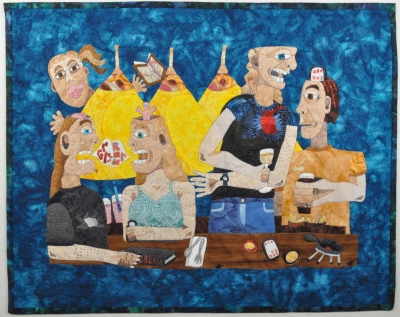
Mar 18 13 005 small

I did read this book cover to cover. It’s my favorite kind of book, full of a good variety of artists and pictures, with nice big pictures of the art, and insights into what the artists think about their work and their process. Yes, I am one of the featured artists, but if I didn’t like the book, I wouldn’t be giving a positive review.

Martha Sielman did a great job tailoring the questions to the specific work of the artists and providing us with some people we’ve all heard of and some who were merely blips on my radar (and even some I’d never heard of, which just means I’m not listening hard enough).

The profiled artists include Joan Sowada, Bodil Gardner, Maria Elkins, Colette Berends, Pat Kumicich, Sherry Davis Kleinman, Cheryl Dineen Ferrin, Yoshiko Kurihara, Lora Rocke, Margot Lovinger, Ulva Ugerup, Viola Burley Leak, Margene Gloria May, Lori Lupe Pelish, Sonia Bardella, Leni Wiener, Mary Pal, Jenny Bowker, myself, Pam RuBert, and Carol Goddu. Each featured artist had about 6 quilts pictured on 6 pages. I liked that each artist covered topics that were specific to their work and lives. In trying to answer interview questions in the past, I know that trying to answer wide-open and vague questions is difficult. Sielman definitely did her homework before sending out questions to the artists, and you can clearly hear the artist’s voice in each section.

There is a wide variety of work here, from the more realistic work done by Bardella, Elkins, and Rocke; to the more abstract pieces of Pelish, Burley Leak, and May; into the whimsical and expressive work of RuBert, Ugerup and Gardner; to Pal, Dineen Ferrin, and Bowker’s intriguing and revealing portraits of particular people. I was fascinated by Kurihara, Berends, and Goddu’s use of fabrics, although they don’t work in a similar fashion at all. I have been lucky to have been following the work of Lovinger for years, and Wiener’s blog is a great background to how she creates her work. Sowada and Davis Kleinman’s work have been on my radar for a good long time, and Kumicich is a recent find, as she is one of the artists in the I’m Not Crazy exhibit I curated.

I would suggest reading Elizabeth Barton’s review as well…she makes an interesting comparison between this volume and the Nature volume of Art Quilt Portfolio. She brings up a point that I also noticed, that there is no contact information in each artist’s section, and even the information at the back is fairly sparse. Although I know how to Google, it would be nice to have that information, even if half of it were out of date by publication…maybe that is why they leave it out.

I mentioned when I reviewed the Nature volume that I liked the galleries of other artists, but they seemed to make more sense in the Nature volume. There were logical topics. I suggested that for the People and Portraits, coming up with gallery titles that were relevant and yet were a means to gather work together would be difficult, and I was apparently right about that. I’m not sure I see the connections in some of the galleries…it might be OK to just not title them. I did enjoy the variety of other artists working with the figure, especially artists whose work I had not seen before. I think that is one of the great strengths of this type of book, in that it is not predictable, that the artists we might expect to see profiled here were not necessarily the artists chosen.

I’m looking forward to seeing what Sielman comes up with next. Again, if you want my copy, comment…