Category: Art
Protected: Not Making Art
Protected: Themed Art Shows…Why?
Protected: Cool Stuff Rolling Round the Nets
Educating the Art Quilting Masses
I’ve been watching Quilting Arts TV episodes while ironing over the last week. I actually have all but Season 1 (there are 8 seasons), although I have to admit that some were gifts and some I bought when they were having a special deal.

You might wonder why I, freaky art quilter, would be interested in these at all. It’s true they are heavy on educating the dabbler in the art quilt world. I don’t think this is a bad thing for most people. Each episode is 30 minutes and usually has 3 segments that are related in some way. During a single season, a demonstrator may be on two or three episodes. There are some interesting sections with art quilters talking about technique, process, and inspiration.
I do get tired of the cute little gift projects (although I saw one the other day that might work for Xmas, so there we are); I don’t want to make my own totes or petwear, although I admit that some people will, and some people just were way too nervous to watch. Most seemed knowledgeable about their process. There is a regular section on the later episodes called Save My UFO, where viewers send in a quilt they don’t actually know how to finish and Pokey and another artist make suggestions. This is interesting to watch, but I think it’s because I think this is the strangest idea…half the time I think the suggestions are wacky (a couple were right on, but they mostly involved redoing the whole thing); the other half make me want to bang my head on a desk. That said, I’m not your standard art quilter, so my judgement might be a bit off. I think artists (and artists-in-training) should be OK with abandoning or completely ransacking a project if it’s not working.
That brings me to a blogpost I was reading comparing Fons and Porter’s quilting TV show to QATV (how can I not like someone called The Cranky Quilter). The writer describes art quilters in a particularly offensive (and yet often accurate) way (um, yes, I miter and do all that stuff)…I laughed at her descriptions, because some art quilts do look to me as if someone watched a season of QATV and then used every technique they could on a single quilt. There is something to be said for at least a few basic art classes, whether art 101 or drawing or painting…although there are some outsider artists who just have an eye for balance and composition genetically. Mostly though I think there is a stage artists go through that is all learning and not very pretty, but it’s all very normal.
Just so you know, the season DVDs are a whopping $39.99 each, but they often go on sale if you buy more than one at a time. They have also started selling single episodes of seasons 6 and 7 for $3.99 apiece, so potentially you could skip the ones you don’t want. There are about 13 episodes per season, so it is cheaper to get the whole season.
I should also out my serious early addiction to quilting shows, back when my local station would actually schedule them…that was years ago. I contacted my local PBS station after they cancelled all the relevant shows, and they said there wasn’t enough interest. I only half watch any TV (right now I am sitting through the 2nd episode of West Wing…again…because my TV-viewing partner never saw all of them, so I am writing this instead…this was started during the boychild’s piano lesson), so it’s not like I’m avidly watching. But I did stop what I was doing to listen to Jane Dunnewold and Deidre Adams and a few others. Ideally, your local PBS admits that quilters watch TV, and you don’t have to pay for the episodes. But I can think of at least a few of my readers who shouldn’t watch at all, because it will just irritate them…you know who you are.
Also, sometimes the projects just don’t work very well…mostly in surface design. I guess that’s true in real life too.
Another way the masses might get educated would be the eMag In Stitches, also published by the QA people at Interweave Press. I would like to like this…
But I just cant get into them. They’re hard to remember to look at, and I can’t get through them in one sitting. If I had an iPad, it might feel more portable…I usually read quilting mags while cooking dinner or waiting for soccer to start, so having it on my home computer is not particularly helpful.
I like the short videos…they’re short enough that I don’t need a big chunk of time to watch them. The other things that slide around or pop up just seem to be there because they can be. In Stitches was $14.97 for the first 3 issues, but dropped to $9.99 for the most recent issue. I didn’t analyze whether the newest issue is shorter to match the lower cost; its interesting that they have adjusted the price…it implies that people weren’t willing to pay the higher price.
There are other free downloads from a variety of places; I see offers all the time, but rarely download them, because I probably will never look at it again if it’s on my computer. Often they are just like a printout on a screen, hard to read and scroll through.
Educating oneself in quilting stuff doesn’t have to be a download or a long video…there are many classes online. I can only talk about those I have actually experienced. I would highly recommend Jude hill of Spirit Cloth. I would suggest you read her blog for a while before choosing one of her workshops. I think she is doing a great job of encouraging people to do their own thing (although some will always copy), but her style will not appeal to those who want direct instruction. She has workshops that run from 1-6 months, and she now has classes where you work on your own, presumably watching her videos and reading instructions without group interaction. Those run from $29-39, with her workshops running more than that.
One of the early online class companies was Quilt University. They claim 90,000 students in 2500 classes over 11 years. Classes run about $9/week, with classes lasting 3-4 weeks (some longer) and costing $27-64. Both my mom and I have taken multiple QU classes…mine were mostly batik and dye classes, but I liked that I could work at my own pace…it’s been years since I’ve taken a QU class; I can only assume their interface is continuing to be updated. It was easy to use a million years ago; I doubt that’s changed.
The last person I’ve taken online classes from is Susan Sorrell of Creative Chick Studios. She teaches creative hand-stitching and collage techniques with fabric. Classes cost from $25-60 and run from 2-6 lessons. She has a great sense of humor and gives lots of ideas while encouraging students to branch out from her style.
So educating yourself in new art quilting techniques (new to you, not new to the world) is not difficult. You just need money and either the Internet or a DVD player. If you are experimenting, I would suggest getting a group together and sharing the cost of materials. It’s even better if you can find a member of your group to teach a technique they already know, which may help you be more successful. Or you can work alone at home, like I do, with the help of an online community, such as those provided by Jude, QU, or Susan…your choice. You can also figure it all out on your own…but assume some of it will be a UFO that not even Pokey can save. Please.
IQF Time Warp 3
I’m up after a whopping 3.8 hours of sleep, thanks to the teens (it’s only once a year)…I can’t even make tea, because it will make too much noise…I’m only up because one of the girls had to leave super early for a soccer tournament. Ugh. So what better time to finish off the IQF Time Warp of quilts I saw in Houston last November and haven’t had time to post? Yeah. I know. These are pieces that caught my eye…I can’t always explain why…
Lauren Strach created the brightly colored Saguaro Familia, in which she sees a mother and child saguaro.
I thought I had a closeup of the cacti themselves, because her technique was really interesting…lots of texture.
In the Holy Crap Someone Painted That Category is Annette Hendricks’ The Solace of Persephone.
Hendricks was very successful with the painting of Persephone, and the riotous addition of roses adds to the complexity of the piece. I suggest you check out the detail shots of her other quilts on her website…her stitching is amazing.
This quilt, Wings, by Rory Ross, intrigued me because of the work she did to make the tumbling blocks pattern overlay the wing pattern…
Apparently this is a fabric version of a painting she did earlier; it was done with Wonder Undered pieces and then machine-stitched with blanket stitch. Ross quit quilting in the 90’s due to back surgery and this was her re-entry…very interesting to look at up close.
Kathy McNeil created Heron Happiness using applique and sashiko-style quilting on silk dupioni (which just for the record is gorgeous but crazy).
The detail in this quilt is also amazing…on her website, you can see some of her other nature-based quilts (although the interface may drive you crazy)…she wrote an article for Quilters Newsletter about creating her quilts from front to back in applique, so she can move the main focus around on the background and make sure the background doesn’t overwhelm it.
From realism to abstraction…this is Beyond by Kathryn Botsford, part of the O Canada 2010 exhibit…yes, I wrote about her quilt in the new O Canada exhibit as well, so I must have a thing for her chaotic quilts…
This is based on Lonni Rossi’s Typospheres fabric line…reminds me of planets.
The next quilt uses a lot of negative space combined with art-nouveau-like florals…turns out this is Hisae Abe’s Istanbul’s Flower.
She based the quilt on her travels in Istanbul, which I would not have guessed. This is all hand-quilted.
This quilt is based on a tropical birds coloring book, but after looking at some of the coloring book pages online, Donna Gilbert did a lot of her own drawing to make Tropical Beauty.
I do love hand applique, and the trailing vines and colorful birds on this delicate quilt are beautiful.
By the way, the reason I didn’t finish this post yesterday is because WordPress is still deleting parts of my posts as I save them…so I had to rewrite half of what’s above this, and then I got frustrated, so I left it all day (well, there’s the part where I had to drive 5 hours roundtrip to Monrovia to pick up my car and go to a friend’s party and then catch up on some of that missed sleep)…I did finally send a message to WP and hopefully they will figure out what the issue is and fix it. Or not.
Anyway, here’s the rest…
I loved this quilt, but people were always standing in front of it and then I was getting tired of taking pictures anyway, so all I have is a single block…and I don’t know whose it is…and I googled around a bit but didn’t find it, so now I feel really lame about that…but it’s a really cool block!
Lots of tiny details and interesting fabric usage…this was not part of the Baltimore Album exhibit…
This quilt was essentially part crazy quilt, part kimono collection…this is Yoshimi Umemoto’s Dream Story…
based on a class with Sachiko Yoshida, using antique kimono fabrics. The movement across the quilt seems chaotic, but is quite controlled…look at the large flowers and the purple and beige checkerboard as it brings your eye across.
Cynthia Goodwin’s quilt Multiple Personalities has great balance from a distance…
but the best parts are close up…
Goodwin’s thread sketching is impressive and adds interest to the quilt.
This is Hale’aina by Kristin La Flamme…
I own one of her smaller house quilts, and I continue to like the larger pieces as well…the sense of rooting the house in the earth and her use of negative space are both appealing to me…as you can see, because I also have a picture of her Rooted X…
with its focus on the roots themselves.
I love the Andy Warhol aspect of Andrea L. Stern’s Marilyn, referring to Marilyn Monroe…
As Warhol did with Marilyn and soup cans, and Monet with his haystacks, Stern has focused on showing the water towers in all their sequined glory…in real life, this quilt sparkles. I love the bling associated with the object that so many of us ignore.
This piece was also in Long Beach and I had to take another close look at it…this is Shirley Gisi’s The Grandest of Them All…
A closeup shows you the details of her lines…which are quilted and then probably painted…
I thought it might be pen, but she lists painting as part of the process. The colors are gorgeous.
I did take pictures of some other quilts, but I think I had hit overwhelmed state, because looking at them now, I’m not that interested in them. If my mom blogged, you would probably see a picture of every quilt in the show…which might be more interesting for those who can’t go. I do know that I will miss seeing all the Houston quilts this year…it’s too bad that more of them don’t travel to the other IQF shows…trying to pull off a trip in early November, competing for school and soccer, is difficult, not to mention expensive. I guess I can put it on a 5-year plan? Maybe? We’ll see. The trip was definitely worth it…and I enjoyed it…but I probably won’t go again until I have a quilt that gets in. And no, I don’t actually enter the IQF show, so it’s like the lottery…I’m unlikely to win if I don’t buy a ticket. I’ll have to keep that in mind…especially after seeing Stitched and the awards ceremony.
Protected: Ystad, Sweden
Stitched, The Movie
I recently had the chance to see Stitched, the documentary film about Hollis Chatelain, Carol Bryer Fallert, and Randall Cook’s preparations for International Quilt Festival. I did see all three of their quilts in Houston last November, so it was interesting to see them working on the pieces and talking about them. The trailer for the film is below.
My mom wanted me to see it because she said they talked about nudity in the film…well, they do. Cook’s work I Remain features a muscular and naked man (from the back), as do a few of his other quilts, and apparently the quilt caused a fuss a few years back. I remember the Quilter’s Home issue (Jan/Feb 2009) that had shocking quilts in it (hmn. not very shocking, of course), which they also talk about in the film. I loved Karey Bresenhan’s discussion of quilters not being shocked by a bare bottom.
I liked hearing the artists talking about their work and their hopes for it…each of the three artists came into quilting differently and it was interesting to see how the three connect and how they react to winning and not winning prizes. I totally enjoyed the movie itself. Hopefully it will get some play on some national TV (PBS, are you listening?), because it’s an interesting take on the exhibition side of the quilt world. You can buy the film…see the website above. I noticed some of the larger quilt shows were screening it at the shows…so that would be one place to look for it. It’s a little over an hour long.
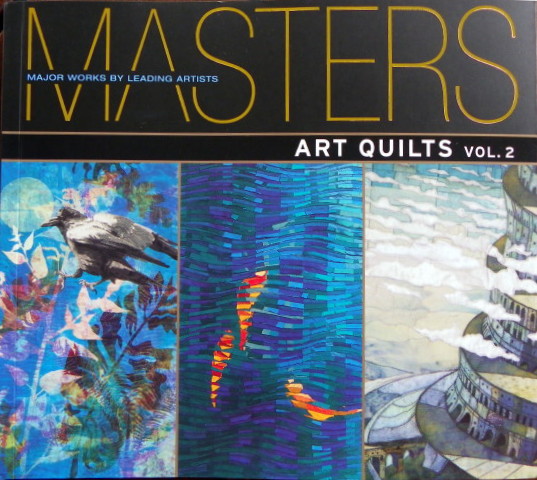
Masters: Art Quilts Vol. 2
I tried to wait before buying the second volume of Masters: Art Quilts, but when I was sitting the SAQA booth at IQF, it was right in front of me, mocking me. I didn’t open it at first, remembering how many days I spent reading (READING?) the first volume, knowing I was supposed to be working the table. That worked for a while; the table was busy, lots of people.
Then they were all gone. And the book was right in front of me. I grabbed it, opened it, saw the first quilt, and had to put it back when someone came up to the table. I did that about 5 times and finally gave up and decided to buy the damn thing.
Here’s the plus to buying it through SAQA…Lark Books is donating the full purchase price of the book ($24.95, worth every penny) to SAQA if you buy through us. Yes. I know Amazon is cheaper, but it doesn’t benefit an art quilting organization that happens to pay for a lot of the shows and publications my work gets into, so I chose to get it through them. It’s in the book sale section under retrospectives.
So back to the book. It’s a hefty beast, at 400+ pages. It focuses on 40 contemporary art quilters, with a few paragraphs on their technique, inspiration, and style by Martha Sielman, SAQA’s current Executive Director and a curator in her own right. I was impressed that I didn’t know all the artists’ names; I love to learn about new artists, and these books are wonderful for that. There are also about 5-10 pages of quilt pictures for each artist, interspersed with quotes from the artists themselves about their process or inspiration. The pictures make the book. They are as large as they can be on the page and in beautiful full color. Lark does a great job with publishing the Masters series.
Some of the artists you may have heard of include Jan Myers-Newbury, Emily Richardson, Chunghie Lee (who juried the Creative Force show that is traveling right now), Genevieve Attinger (in Creative Force), Paula Nadelstern, Rosalie Dace, Leslie Gabrielse, Nelda Warkentin, Dianne Firth, Alice Beasley, Mirjam Pet-Jacobs (in Sightlines), Jane Dunnewold, Laura Wasilowski, Eleanor McCain (juror for Quilt National 2011), Elizabeth Busch, and Dorothy Caldwell. I had seen a few of the quilts in the book, although mostly online. It’s wonderful to have them all in one place…the old Masters volume sits by my bed for pre-sleep perusal. This one can too.
I was impressed by Sielman’s inclusion of more male quilting artists. We know they’re out there, but often don’t hear from or about them, so it was a nice addition. Leslie Gabrielse’s work is very stylized, like art of the 1920s, but includes these surprises of plaid fabric in a woman’s leg that work to make the figure without overly distracting the eye. Arturo Alonzo Sandoval uses unique materials to make his art quilts, including velcro, metal, film, acetate sheets…you know, all the stuff we have around the house but haven’t made art out of yet (there’s still time, and now you have a role model). Jim Smoote was a real surprise to me; I had never heard of him (doesn’t mean much…I’m not the one who knows everything), but his portraits of African-American women are stunning portraits, skillfully placed in a modern setting. Someone please persuade him to get a website! Tim Harding was another new artist to me…I should clarify…I had seen one of his swimmer quilts before, but didn’t realize at the time that it was his work. His use of silks and folding the fabrics artfully treats the subject of water and swimmers…his vision is intriguing.
It’s hard to choose who else to focus on in this review…I really do feel that if you are working in or interested in art quilts in any way that you should own both these volumes. This book has a range of styles from figurative, through abstract, modern, and expressive. There are quilts reminiscent of landscapes, there are those that hint at our traditional background, there are portraits…which reminds me, I had not seen work by Carolyn Crump, and her use of color against the black outlines that looks so much like block printing is beautiful, but when she adds the stitching, the pieces sing. Her portraits are expressive and full of movement.
Bente Vold Klausen was another new artist to me. Her work seems to grow from some sense of violence upon her or others, with abstract figures created from newspaper articles wearing targets and surrounded by darkness. I had recently seen a reference to Izabella Baykova, another international artist whose work intrigues me. She uses sheer fabrics in her work; her figurative stories are wonderfully graphic, like a graphic novel, but so soft like Russia in winter. Her ability to manipulate her materials makes the silks and rayons glow.
The rest of the artists fill out an incredibly strong view of a piece of the current art quilting world. The book is inspiration for those of us working in and collecting quilt art; it contains solid examples of real ART in the fiber world, for those who don’t know what that is. I recommend this series and hope Lark continues to use Sielman’s curatorial skills in the future. For those looking for a voice, for their style, this book will help you to see what that looks like. For those who have a voice, this is pure inspiration and enjoyment.
IQF Time Warp 2
I love that it takes me 9 months to finally get through all these photos. I’ll still be writing about the Scandinavian trip in 2012 probably.
This funky quilt is Color Comes to Back of Beyond, and is based on a colored-pencil drawing by Pauline McPharlin. The quilters are Janice Munzberg, Pam Holland, Pauline McPharlin, and Jeanette Coombes.
The group has done an amazing job making a drawing into a quilt, with the elements coming in from the left and the thread-painting used throughout the piece.
I wish there were somewhere they had written about the process they used; with 4 people involved, one of them a teacher, I’m curious how the delegation of work happened.
Here’s another piece of it.
This one looks like knees and legs to me, all under a big patchwork quilt. This is Pinnacle by S. Cathryn Zeleny, the title implying nothing to do with knees, of course.
The only other image I could find of a Zeleny quilt used a traditional quilt pattern to create these 3D shapes just like this one.
I know this is at a lousy angle, but there were 7 million people in front of this award-winning quilt, Mary Simon Rediscovered, by Nancy Kerns.
The pattern for the Baltimore blocks is a reproduction of a quilt by Mary Simon and can actually be purchased from the DAR Museum in Washington DC. Kerns designed the floral border herself and tried to stay true to the colors of the original piece. I’m a sucker for a nicely done Baltimore Album…it’s better to collect pictures of them than to try to do it myself, right?
I also like crazy quilts, and this one had a unique setting. This is Linda Steele’s Eastern Elements.
I’ve shown her crazy quilts here before (like one a year, I think).
The detailed embroidery and the settings for the blocks make her quilts stand above and beyond many crazy quilts.
Allison Aller’s Crazy in the Garden was inspired by the spring weather in her own garden.
Aller’s control of the color in this piece is very impressive. If you read her blog, you can watch her put this quilt together and make decisions about what goes where. Unfortunately, this piece went missing from a recent quilt market in Salt Lake City, Utah, along with 3 other quilts. C&T Publishing is offering a reward; details are here.
This is Kathy York’s Doors Across Austin.
You can read her statement about this particular quilt here. She dedicates the quilt to her son, who is autistic and doesn’t like change but does like novelty and bright colors. Although I photographed this quilt before I knew it was about her son, it was the mention of Temple Grandin that made me look twice. Temple Grandin is an autistic woman, writer, professor, consultant to the livestock industry on animal behavior, and doctor of animal science who has spoken up for many autistic people, showing the rest of the world that autism is not some sort of strange disease, but advocates early interventions and teaching coping skills. She has written a book about what it was like to grow up autistic, I’ve seen her in a few documentaries, and she has changed how the livestock industry deals with restraining and slaughtering animals, suggesting more humane ways to accomplish the tasks. In the video I watched, she actually gets in pens with the cows and lies down on the ground to get them to respond to her. The Woman Who Thinks Like a Cow is available online in pieces. I linked to the first portion on YouTube, if you’re interested. I’ve watched the whole thing…she has interesting comments on her childhood and her understanding of the bovine mind and how they’re linked.
This is Betsy Abbott’s Tidepool Treasure. This piece has lots of details…
but the bird’s head intruding on the sealife below is what really makes it interesting.
This is Rachel Wetzler’s The World, including work using Inktense pencils and Micron pens.
She writes a little bit about making the quilt on her blog, showing her inspiration from an antique map. Some of the animals are painted directly on the fabric and some are fused on. If you search through her posts for those titled The World, you can see some details and get more information about how she created each portion of the quilt. Note Adam and Eve peeking out in the center middle.
It’s an orange rhinoceros with blue hooves…it’s actually quite a beautiful creature, My Rhino by Pam Holland (same Pam as the one above, I believe).
This is an Albrecht Durer illustration from a few years back (1500 AD). He looks a little cranky carrying all that armor.
The totem pole is beautiful, but the delicate lines of the trees really make it stand out. This is Promise Fulfilled by Kathy Quinn Arroyo.
This is not a real totem pole; she studied the meanings of the different creatures and made a pole specifically for her family.
This is a very long and narrow quilt that is a study for a quilt reproduction of the entire Bayeux tapestry, a mere 238 feet long. This is Pam Holland again, who seems to have a lot more free time than I do, and is producing some very interesting work in that time…
Here is a closeup of one of the sections, so you can see the incredible detail she is putting into this sample.
I love his mustache. What’s also interesting is that I really didn’t pay attention to who made quilts when I took photos in Houston…I just took photos of what I liked and then a photo of the card, but I didn’t read the cards most of the time. I was all into the visual experience and didn’t want to mess it up with words…so for many of these, it’s the first time I’ve read the statement (or connected the fact that I photographed multiple quilts by the same artist).
This doorway was stunning. This is Facade by Melissa Sobotka, who compares the crumbling doorway to her own aging self, finding the original structure still apparent.
This doorway is in Tuscany.
This quilt reminded me of some drawings we did in my beginning Visual Arts classes in college, where we drew real objects and then combine them all into one drawing, then erased bits and pieces to get a final composition. This is actually a train; the piece is called The 844, by Lynne Pillus.
I like the mix of all the parts; you can tell it’s part of a train, but it’s not obvious and it’s colorful too.
A Noriko Endo piece…they seem to get more delicate as she gets more experience with her own technique. This is Radiant Reflections #2…
She writes that she is working on a series of reflection pieces, and you can see the orange of the leaves in the water.
The strange shapes and traditional blocks in the sky caught my eye with this piece, Sandstorm over the White Desert, by Jenny Bowker.
When she travels, she photographs people (and stuff) and then makes quilts from her photographs. The background may have originally caught my eye, but it was the face that made me photograph the quilt…
And check out the sandstorm building up in the quilting behind him.
I obviously will need one more post to get through all of these…plus I am trying to get quilting done in between. Really. I am. It is nice to go back and review these from November, though.