
I keep trying to finish this post. Today is the day.
While girlchild cooks dinner and I try to relocate any mental energy for the evening’s tasks, I am writing my last Quilt National 2013 post. The one thing that never really shows up in the show catalogs are detail shots…this is why seeing them in person is always better…as before, if I didn’t put a link in on one of the two previous posts, I will put it here. Otherwise, you’ve gotta go back and read Quilt National 2013 and Quilt National 2013: The Artist Talks. Know that I write these posts more so that I will remember a year or more from now what I saw and what I thought…you’re welcome to come along, but I’m all about documenting.
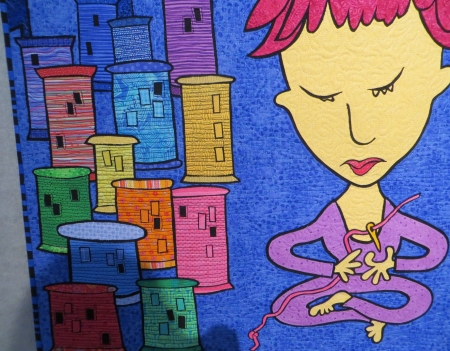
This is a closeup of Pam Rubert’s Seattle–Wish You Were Hair. She does a lot of patterned stitching on her pieces.
Lisa Kijak’s piece El Cortez, Las Vegas, is made up of thousands of pieces. On her blog, she talks about a special piece of rust-colored fabric that she used in this piece…

Paula Kovarik’s piece Round and Round It Goes…I could stare at it for hours, just tracing my finger along the line and finding the frogs and the birds and the just crazy number of animals in this piece.
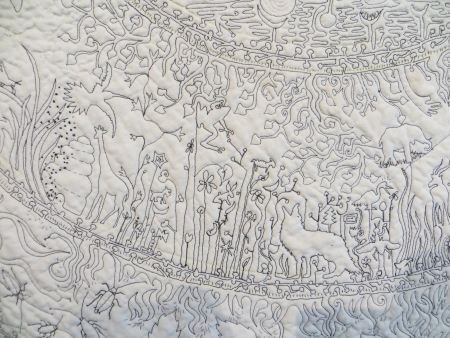
I talked to her more than once, but my brain was all crazy with Quilt Nationalness…now I wish I could sit her down WITH the quilt and say…OK…how? Time? Drawings? Hours? WOW.

It’s just too amazing for words.
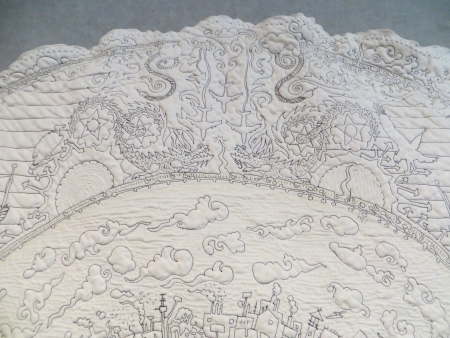
Brienne Brown’s Moonset is a similar technique…but hers are all sea creatures in a smaller space. Her silk deals with light much differently than Kovarik’s recycled cotton tablecloth.

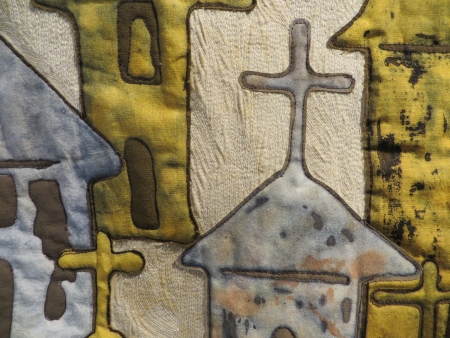
Susan Lenz’ Circular Churchyard is grave rubbings with crayon, all overlapping in space.
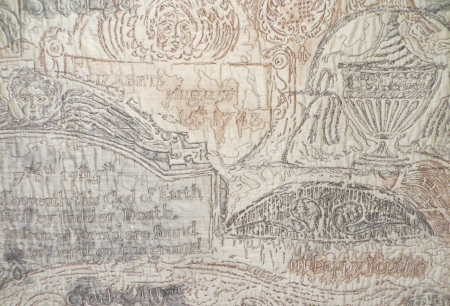
I’m amazed by her ability to decide what goes where on a wholecloth piece like this. It works. It seems like it wouldn’t, but it does. And she did all the rubbings in one go, in the cemetery.

Brigitte Kopp‘s Hands off!–Hau ab! is about child abuse and how children deal with it, what their body language and facial expressions tell us.

Sidnee Snell’s Riveted reminds me of Kijak’s work, with the glow that comes from many layers of fabric working together to make this beautiful section of a steel bridge. Snell talked about the many trips she has taken over this bridge and the many photos that she also has of it.
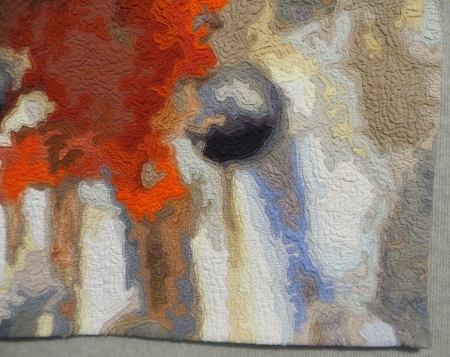
Eleanor McCain and Kevin Womack’s piece Swaddling to Shroud–Birthing Bed, is largely made of digitally printed fabrics. Some of the detail shots remind me of the unit I was just teaching.

Yup. Them’s some ovaries!
Brooke Atherton’s piece SpringField is full of these details of objects sewn on and into the work.
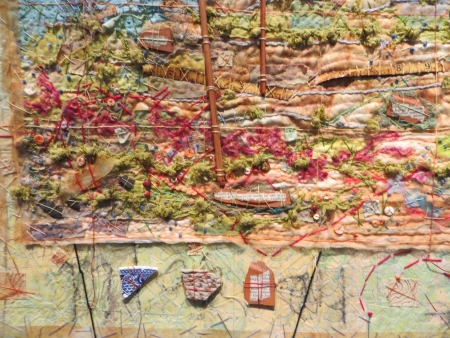
You could stare at it for hours and wonder what each thing meant (and she said they DID mean stuff).
I had a conversation with Leslie Rego about how her piece Four Seasons at the Beaver Pond glowed, about how the silk was part of what made this piece look so much more beautiful in real life.

She thought it looked better in the book…she’s wrong. This is so much deeper in real life. None of the photos do it justice.
Miriam Nathan-Roberts used her stitching to help with the illusion of glass reflections in her piece Salt & Pepper.

I don’t have a full picture of Arle Sklar-Weinstein‘s piece Truth or Consequences, but here is a detail of one of the nuclear pockets with leftover bits and pieces sewn in.
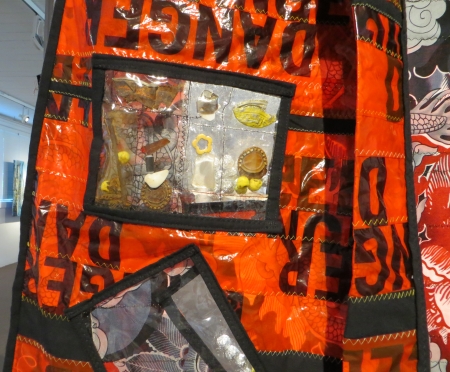
Here is a closeup of Dianne Firth’s Storm, showing the felt and the tulle that make up the piece, as well as the shadows thrown on the wall behind the piece.

This is a detail of the center of Bonnie Peterson’s Kora (Pilgrimage), showing some of the hand embroidery.
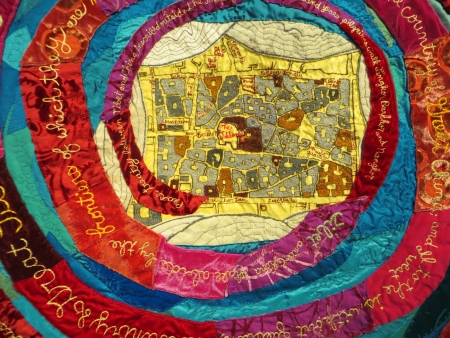
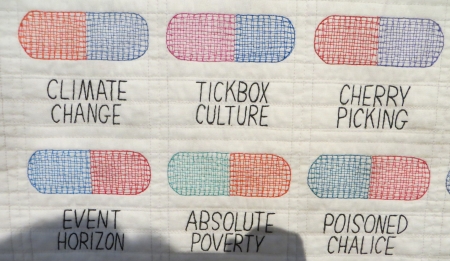
And some of Sara Impey’s bitter pills are in this photo…too bad my camera can’t handle lighting.
Sheila Frampton-Cooper did some very tight background quilting in her piece From a Seed, imitating the rain in the background.

This is a closeup of the very tight yet random-looking stitching in the background of Mary Rowan Quinn’s High Expectations.
This detail shows the scanned and built-up leaves in Barbara Schneider’s Forest Floor, var. 2.

You can clearly see all the torn-up bits of Susan Brook’s Together in this photo: from ugly fabric (her words) to a coherent piece.
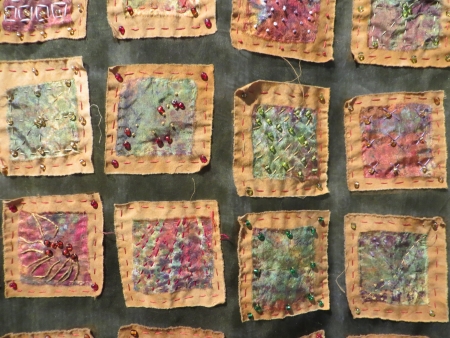
In the detail of Lorie McCown’s My Grandmother’s Dresses, you can see how the simple dress shape takes on character with the wrinkles and the stitching.

Elin Noble, who received the Quilts Japan Prize for her piece Fugitive Pieces 11, dyed her fabrics and her threads. This is another piece that is completely different in real life.

Carol Goossens’ piece As Summer Slowly Fades… details the red-winged blackbird. There is an intense amount of hand and machine stitching on this piece.

Cathy Kleeman thoroughly covered her piece Post No Bills with paint and marks after it was quilted. You can see how the marks lay on top of the fabric texture.

Marianne Burr‘s hand stitching is apparent in this detail of Thru the Lens.

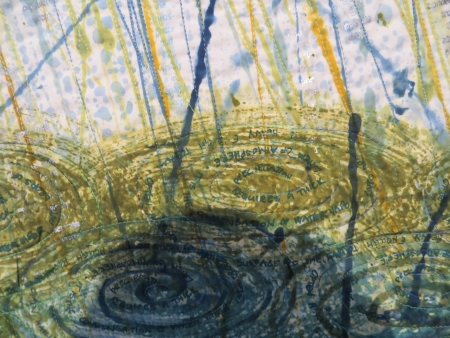
Sandy Gregg’s pools of water give up words in the detail shots of Listen to the Rhythm of the Falling Rain.
Robin Schwalb’s Jive Boss Sweat shows words and big stitches in the detail.

The distinctive drawing style of Kate Sturman Gorman in her piece Bernadette in Artichokes shows up her detail, along with the hand-stitching in the background.

Dinah Sargeant’s long, skinny ribbons of dyed fabric and the vague details of her figure’s face and hands are clearer in this photograph. Someday I will remember to ask her about whether she plans the faces or whether they just appear in the fabric.
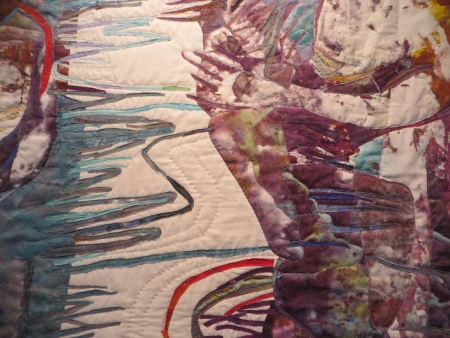
Susan Shie’s detail of Dragon Sushi has a wonderful quote: “Beware of Artists…They mix with all classes of society and are therefore the most dangerous.” She has made this into a digital print for purchase, available here…

A detail of Anne Smith’s Gabriel shows the details of embroidery and fabric choices, which seem chaotic until viewed in the whole.
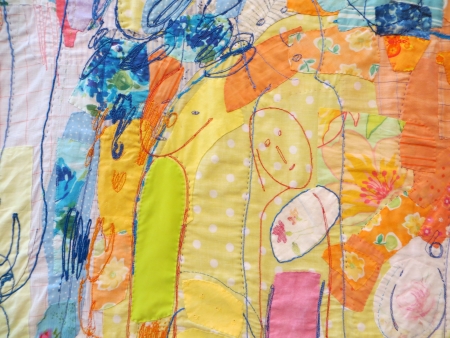
Peggy Brown’s detail of Soliloquy II shows some of the paper she used in her quilt.

This detail shows the marbled patterns in Karen Tunnell’s Bubbles.

This detail of Vintage by Carol Watkins shows the contrast between the printed background and the heavily thread-painted car.

The detail of Cris Fee’s self portrait, Contemplating Self, shows the heavily stitched eyeball.

Pamela Allen’s buildings in My Town by the River are a modpodge of fabrics and printed words, held together with hand and machine stitching echoing roads, textures, and flowers.

Deirdre Adams’ Tracings III is a texture party…detail shots reveal things I would never have seen while staring at the whole.
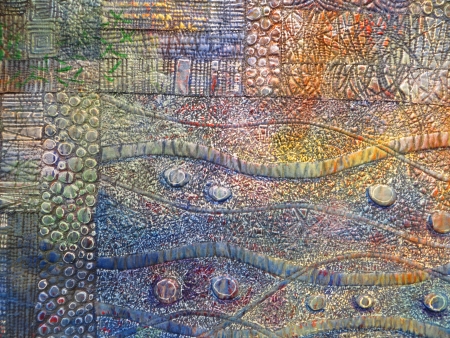
John Lefelhocz’s Mona in the Era of Social Butterflies reveals letters in each box that look like keyboard keys, typing a message into the image of Mona.

I think this was my mom’s detail shot of Barbara Schneider’s leaves in Forest Floor, var. 2.

All in all, I think the best part of the Quilt National experience was getting to spend so much time with the quilts and their makers. I rarely get to see a show over and over again, and hope I have the chance to visit again…and hopefully the brain power to remember to ask all the questions about their work that vanished as soon as I was in the artists’ presence. One can only hope.
Now I can finish cleaning my studio and putting the QN 2013 book in the bookshelf with the others…it was a great experience.
 Kathy Nida
Those are some amazing pieces and there’s so much variety! Thanks for sharing them. I’m most enthrall end with the ones with tight background stitching. It’s almost like using the thread as a kind of textured paint. There’s so much dimension and detail.
LikeLike
Greatly admire Paula Kovarik and her work. You aren’t chopped liver yourself, either.
LikeLike