
Plenty of people have posted about QN who were actually there…some of us weren’t able to see the show in person, so the book is our only option for viewing the exhibit. I’ve reviewed QN (and Visions) in the past, and I often wonder about the concept that these two shows are supposed to be examples of the “future of the art quilt medium.” Maybe it’s because I come to art quilts from the other art world, and there is very little I would consider cutting edge…which isn’t to say there isn’t plenty I see that is intriguing, entertaining, interesting, and worth viewing.
The plus of having the book available us is an introduction better explaining the jury process, for those who can’t imagine choosing 85 quilts out of over one thousand entries. I know a different jury would have picked a different show.
The other plus of the book are the juror statements. Nelda Warkentin specifically explains why many of the award-winners received their awards. It’s not artspeak…just simple explanations that explain her feelings about those pieces.
Eleanor McCain asks what makes fabric and thread a necessary part of these works of art? She also talks about the place of the quilt in the art world and in history, especially as it relates to women and their place in the art and domestic worlds.
Pauline Verbeek-Cowart is a weaver, and as such, brings a different viewpoint to the jurying. I was interested in her comment that she was looking forward to seeing something new and different, something that would show new direction or would inspire her to new directions in weaving…and she “was initially disappointed” by the lack of “groundbreaking new approaches,” such as those she has seen in the rest of the fiber world, mostly technological advances, like the use of digital technology to create truly new types of work. I personally don’t feel the need to explore new materials at the moment just because they exist…that may change in the future, but for now, I an more interested in how best to convey what I’m thinking.
Another thing about juried shows is realizing that you can’t possibly make a quilt aimed at the specific jurors’ styles. With three jurors voting throughout, the final exhibit is what they all agreed on, whether their personal preference is all brights or stuff with metal bits or really abstract.
In talking about the quilts themselves, I must admit that I’m only looking at pictures in a book; I would love to see them in person, but I am limited by my location far far away from Ohio. That said, I always, as a more pictorial quilter (I’m not sure there really is a word for what I do…figurative? surreal? graphic?), I am always cognizant of the fact that the majority of art quilts in QN seem to have either a block-based construction or are truly abstract (or both). Perhaps it is because the medium is based in traditional block construction and that is where most quilt artists hale from…they started with the 9-patch and strip-piecing and branched out from there? That said, there are always those working in blocks whose work transcends the structure…Wen Redmond’s Leaping Point goes well beyond the block…and beyond the limits of photography as well…I love to see photography used to further the image, instead of just BEING the image…she’s incredibly successful in this piece on both fronts. You can see Wen and her piece on her blog here. Deidre Adams’ work Facade VII also mutates the block with the use of paint over the constructed piece, with the numerous quilting designs emphasized by the paint. The block is there, but does not own the piece. Deidre’s blog has an amazing post on the opening of QN 11 with pictures of many of the attending artists with their pieces. I would suggest her blog as a good read for general information on fiber art in general, as she had a good number of posts about the SDA conference as well.
The abstract pieces (including the block-based pieces) dominate the show. Although I don’t work very abstractly, certain of these pieces do excite me…I wish I could see Kim Shearrow’s piece Sunrise at Age 45 in person. It’s created from recycled materials and looks to me like the sun is rising in the piece. I can’t find a website for Shearrow, but I did find this video of her talking about how she started quilting with tissues. It seems that experimenting with different materials is her thing at the moment. Caroline Szeremet’s piece Oil Spill is another abstract piece that caught my eye, with the quilting seeming to add to the piece…it’s hard to tell without a detail whether all the stripy bits are from quilting or whether they are from paint (I suspect a combination of the two). Her piece Oil Spill 2 was recently in Form, Not Function 2011 also. It’s hard to tell from her statement whether she set out to make quilts about oil spills in particular…she says “The title comes from the impression this work naturally evokes”…but I definitely get a sense of world and nature from both pieces.
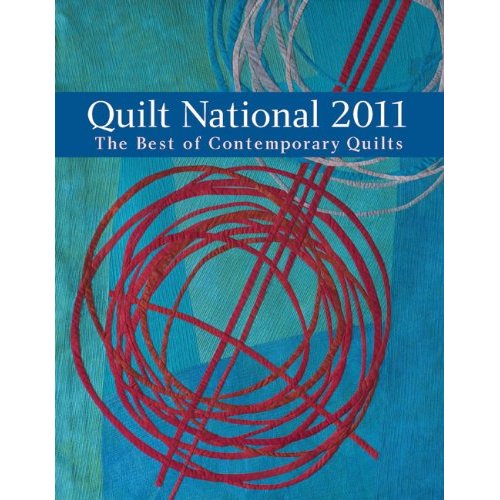
Continuing with the abstracts, Judy Rush’s piece Portrait of the Youngest Girl 1 attracted my attention, largely because of the repetition of the star shapes across the piece. I actually liked it better before I saw the title…I didn’t see a face until then, and it just was this shape almost like the human heart, very abstracted but with movement around and through the piece. If you go to her website, in the 2010 gallery you can see the piece that got into QN, but also two other pieces in the series. The star shape repeats throughout quite a few of her pieces, but I like the second portrait the best…it seems more interesting in terms of shape and stitching, although it may just be that it looks the least bit like a portrait…I’m not sure why the title set me off so much, but now I can’t even look at it without seeing a face. Strange. Judy Kirpich’s piece Circles No. 4 (the cover quilt, seen above on the book cover) also caught my eye…the graphic nature of the overlapping red circles are made even more interesting by the addition of the turquoise and silver circles above. I just added her blog to my reader after skimming through her comments on how she creates and how sometimes she doesn’t know when to stop making circles and lines. Elizabeth Brimelow’s piece Rook Road caught my eye at first, but it wasn’t until I saw the piece fullsize on someone’s blog at the show that I realized it was even more interesting than I had thought, with the pieces scrolling over the top bar and onto the back. Her explanation is that this is the view of the land from the rook’s point of view, like a map of where to find food and water. In looking her up on the web, I realized I’d seen and admired her pieces before, although this one does not obviously follow from the others.
Dinah Sargeant has always been one of my favorite quilt artists, and although I don’t really consider her piece Pink Dog Blue Rain abstract, I guess it technically is a mix between abstract and picture. There is just enough of a real picture there to see more happening than she explains in her brief statement “Fragments from the day gather in the night”. I’m always intrigued by her process, and she doesn’t give many details about that, but in her statement claims she starts with paint, and then “I venture into a world of colors and shapes, where ethereal creatures and places beckon realization. Beings appear and planets align. I stitch them all together.” Her work, as always, begs me to stand and stare. Anne Smith’s piece Mother me Mother you also makes me stare…the elephant is quite clear to see (even with heels on), but the detail drags you in and won’t let go. I don’t know if this is the same Anne Smith who won QN 09; her web presence seems to be nonexistent since then, and the countries, although close, don’t quite match up. I keep looking at Barbara Schneider’s piece Reflections, Variation 13, Honfleur, France, and trying to decide if I like it…I think the lines throughout the piece keep drawing me back to it, and I suspect seeing it in real life would make it or break it for me. Looking at the size of it, it probably has more of an impact in real life. This is one of the things I hate about only seeing pieces in print and on the web. Comparing it to her other reflection pieces on her website, I think what makes this piece for me is the inclusion of the narrow reflective lines…I don’t really care what was reflecting in the water, but the constrast between the heavier thick lines, then thinner lines, then the even thinner quilting lines makes this piece interesting. I also kept going back to Shoko Hatano’s piece Color Box #13. Like Adams’ piece, she seems to have heavily quilted the background and maybe painted on top, but I really like the contrast between the background and the paintbrush-like strokes that start all pink and happy and become dark and obliterating on the righthand side of the quilt. Reading her statement about global warming seems to add to the feeling that something very bad is about to happen.
There are a few pieces in QN 2011 that are fully representational. I have to admit that I am not a fan of printing a digital photo on fabric and then adding to it (Redmond’s piece, as I said above, seems to transcend that technique), but I do like me some pictorial quilts, however few and far between they are in the quilt ART shows (they are all over the place in the quilt SHOWS, but there they rarely extend beyond copying a photograph). I quite like Carol Watkins’ double view of the earth in Reflections on Duality, whether we destroy the planet or make it our priority…her piece clearly shows the effect we have on the earth. She used photography as part of her process, so that shows it is possible to make it work for you in a positive way. I especially like how the quilting in the water in what I think of as the “living” piece versus the “dead” piece reflects the status of the lake (edited to add: Carol emailed me about her process, letting me know that her “image actually is a combination of a number of photographs layered together. Then there is additional photo manipulation as well as extensive free motion thread work and applique.” She also confirmed that seeing the pieces in real life is a much better experience than reviewing them in a book, of course!). Olga Norris’ pieces have always intrigued me with the lack of facial expression and the hand-quilting providing texture and emotion, and her QN 11 piece Ponder is no different. She talks about body language, and certainly the concept of “ponder” seems obvious once you’ve read the title, but I do see the figure on the left as more struck by whatever the two have been discussing.
After saying photorealism is not my thang, I have to talk about Tanya Brown’s piece Farmer Brown, mostly just to embarrass her (not really), but to make you look at the delicate shading in his face. Facial colors are so difficult to render well; she has outdone herself on the careful shadows under his nose and eyes. From reading her blog, I know for a fact she spends a million more hours per quilt worrying about the perfect quilting line, and all that energy shows here in a positive light. Opposite from photorealism is B. Michele Maynard’s graphic piece Vera Loves Her Gun…man, I don’t doubt that she does! I think the use of black line in Vera’s face and the flowered jacket against which that big black gun rests.
This limited list of quilts I liked doesn’t mean I won’t like something different tomorrow or the next day, or that seeing them in real life might make me totally rework my list…but I do hope you go check out the artists’ websites when I could find them. I seem to learn more about the specific pieces when I see other work the artist has done…it gives me more insight into who they are and how they work than just seeing a single piece in a gallery. I do also recommend the book, although I have to admit that I own ALL the QN books from the first one on (and Visions as well), because for me they are a way to see art I might not otherwise see. There is nothing better to do on a nasty day than make a cup of tea and drag out all the art books you have to lose yourself in the pages. With that in mind, I do have an extra copy of the book, so if you are interested, send me a note on the contact form on this website; I’ll mail it to you. I figure if you read through all of this, you deserve it.
 Kathy Nida
I have the book so I enjoyed following along while reading your post. I want to thank you for an insightful look at these quilts. It helps me to have someone who understands art to guide me through.
LikeLike
Right on about the issue of representing the “future of the art quilt medium.” I want to see a quilt with an air car on it, darn it! Or one made with nanotechnology, including its own electron microscope for viewing purposes.
LikeLike