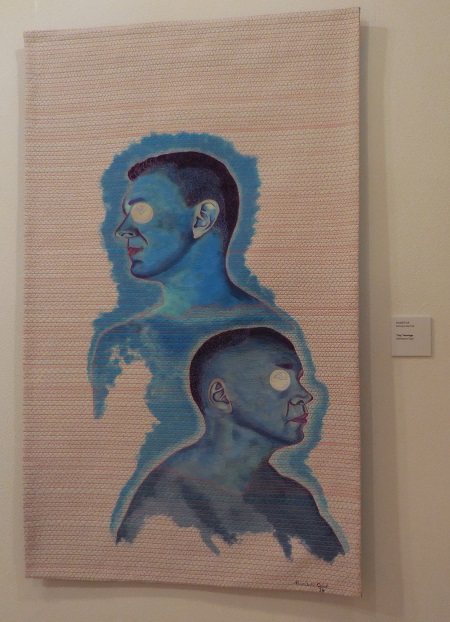
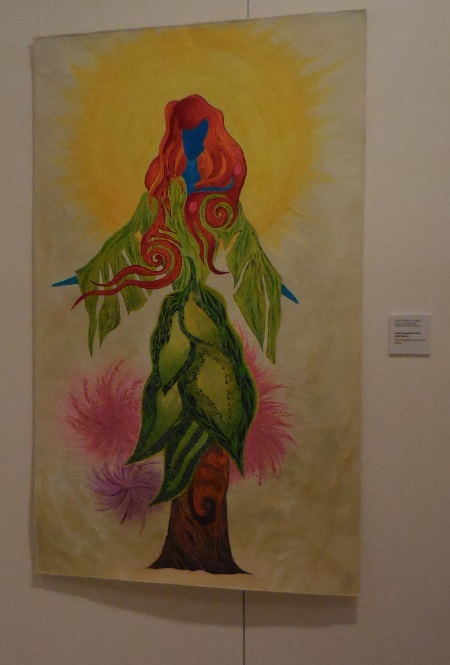
Expressions in Equality Exhibit

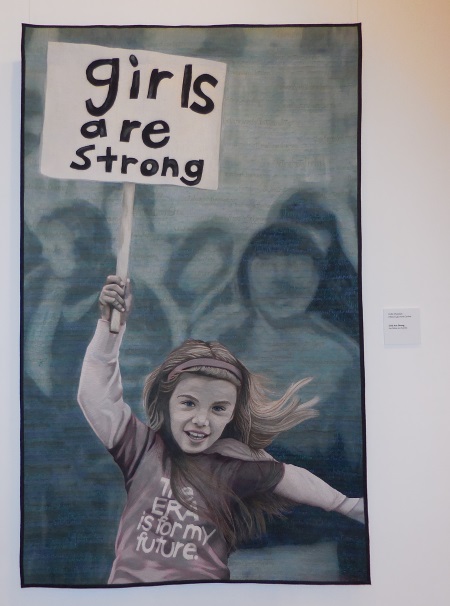
So the Expressions in Equality exhibit opened Saturday night, and it has some amazing art in it…Hollis Chatelain’s Girls Are Strong being one of them…
Jan 19 15 011 small

Visions Art Museum does a nice job of allowing the artists to preview the show and take pictures, so here are Pam RuBert and Susan Shie’s pieces…
Jan 19 15 001 small

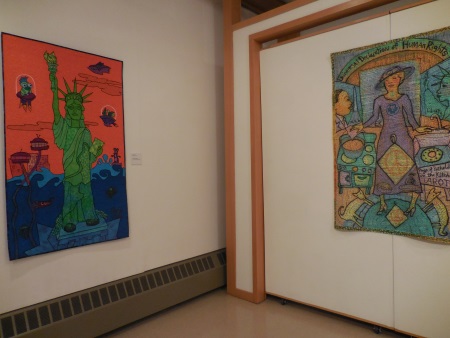
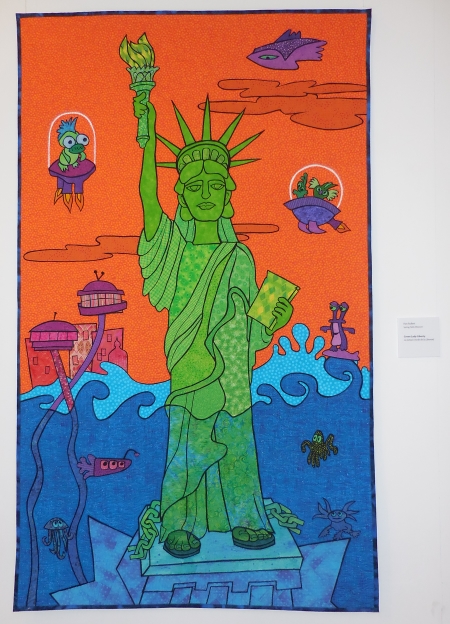
RuBert’s wonderfully colorful Green Lady Liberty, spaceships and all…
Jan 19 15 020 small

And Shie’s ER: Page of Potholders (Coins) in the Kitchen Tarot

Jan 19 15 019 small

which I did not have the presence of mind to read, so I will have to go back (I don’t deal well with openings).

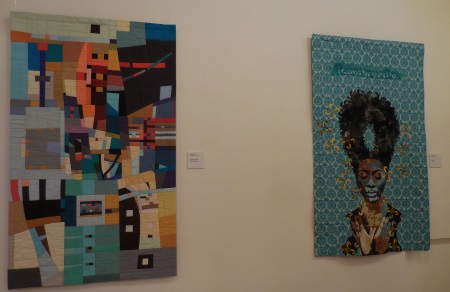
Compared to the last exhibit at VAM, this was much less abstract, although Freedom of Speech by Susan Wessels is an abstract piece I like, with Deborah Grayson’s Breaths to the right of it.
Jan 19 15 017 small

Pauline Karasch Salzman’s Lessons Learned is another one to come back and read, with Ife Felix’s Reverend Dr. King’s Dream Unrealized to the right.

Jan 19 15 016 small

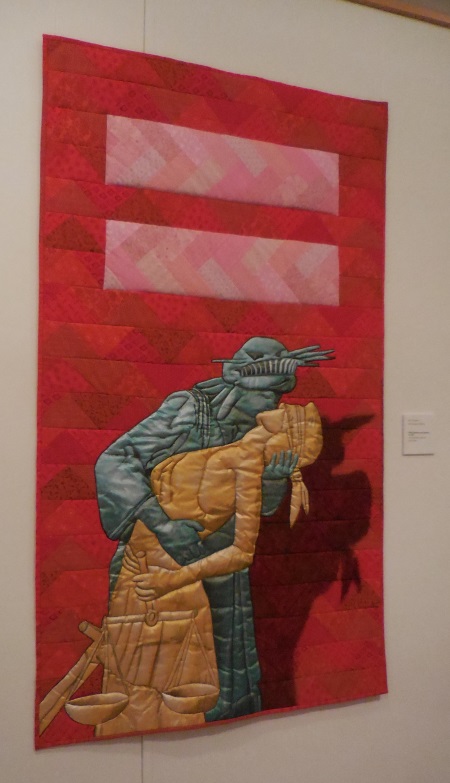
Jerry Granata’s With Liberty and Justice for All definitely caught my eye…
Jan 19 15 012 small

And Shin-Hee Chin’s Equality: Expanding Circle of Liberty shows the continuing expansion of her techniques…

Jan 19 15 009 small

I wish I had gone back and taken more photos here…from left to right is Dawn Williams Boyd’s graphic Sisters in the Eyes of Men, Sandra Lauterbach’s Story of the Wall, Chin’s piece, Judy Zoelzer Levine’s Together on the Field of Play, Alice Beasley’s No Vote No Voice, and returning to Chatelaine’s piece.

Jan 19 15 008 small

In the back, they hung my Work in Progress with Randall Cook’s piece…

Jan 19 15 007 small

Here is Cook’s “Gay” Marriage…

Jan 19 15 006 small

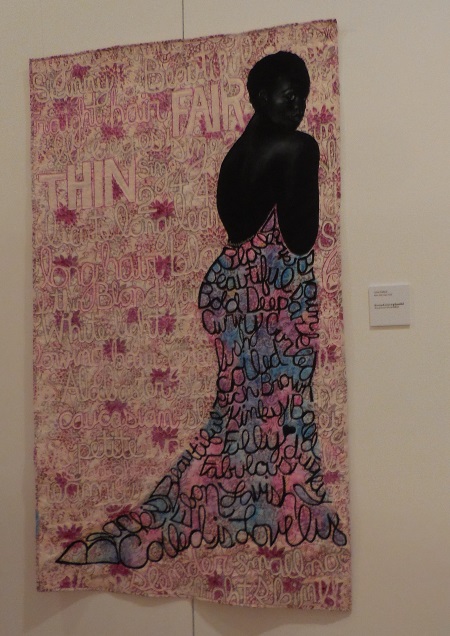
Laura Gadson’s B-R-O-A-D-E-N-I-N-G Beautiful, an amazing piece made mostly of words and the eye staring back at you.
Jan 19 15 005 small

The curator, Sheila Frampton Cooper’s piece, Marie Magdelaine de la Saint Baume

Jan 19 15 004 small

The quilting on that piece…I should have taken details!

Mary Pal’s The Other 1% hung next to Patricia Kennedy-Zafred’s Tagged, with actual tags hanging from it.

Jan 19 15 003 small

Blake Chamberlain’s Harriet Tubman was fascinating to look at up close…

Jan 19 15 002 small

And here’s me with my piece, finished! Hallelujah…

DSC03192 small

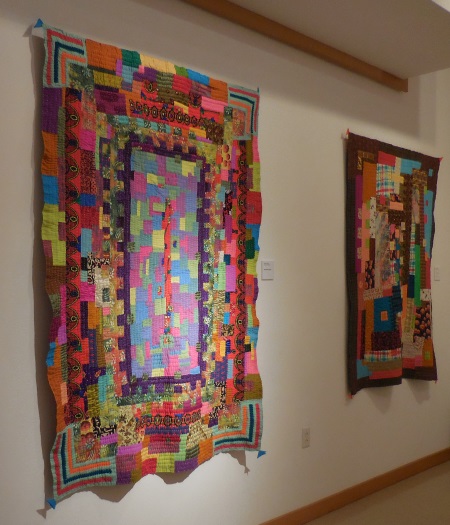
The back room has the amazing Margaret Fabrizio’s work…
Jan 19 15 015 small

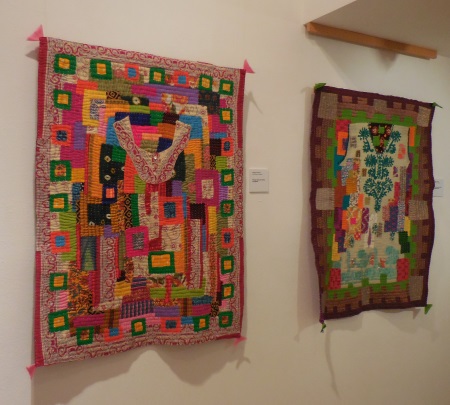
Margaret is every bit as amazing and colorful as her work…
Jan 19 15 014 small

She traveled to India to learn how to make these. I love talking to her; she is interesting and funny and always has an opinion on the topic at hand. Plus she has great clothes.

I did not take photos of every quilt, unfortunately (distracted by people), but this is a strong show, well worth visiting for, although I would have liked shorter statements about each quilt hanging with them and in the gallery guide, which should be available this week. I missed Sherry Davis Kleinman and Marion Coleman’s pieces (there were always people standing in front of them). They did have us write longer statements for the docents; presumably if you were in the gallery, someone could produce a book of those for you to read. There is a hope that this show will travel, but perhaps you will have to travel to it…it’s at VAM through April 4.

People and Portraits Exhibit

I went to the Houston IQF show mostly because I had two pieces in the SAQA People & Portraits exhibit, which is based on Martha Sielman’s book Art Quilt Portfolio: People & Portraits. We got official pictures of the exhibit, which travels next to the Texas Quilt Museum in La Grange, Texas, from January 9-March 30. Here was the entry to the exhibit at IQF.

entrance small

Turning directly to the left, the first artist is Margot Lovinger, who works in layers of sheers and tulle. Maria Elkins is next, with her portraits combined with traditional quilt patterns. The cover shot from the book is in the exhibit, but her more recent piece, Surrender, has a heartbreaking story that goes with it here.

LovingerElkins small

Next comes Margene Gloria May, whose portraits are made from a variety of different fabrics, including a wrinkled shirt and tie in the piece on the right.

May small

Joan Sowada‘s work is next, with overlapping views of skateboarders and a closeup of a loving couple.

Sowada small

Lori Lupe Pelish‘s work has fascinated me for years, with the busy fabrics she uses to make up her portraits. There are two pieces here: the mother and child on the left, and then a quadtych (is that a word?) of 4 pieces. Her work requires closeup viewing and then a step away for the big picture.

Pelish small

Pat Kumicich‘s work is in your face. These aren’t pretty portraits…you need to take a closeup look.

Kumicich small

Cheryl Dineen Ferrin does portraits of people she meets or knows, especially in motorcycle groups.

Dineen small

Pam RuBert‘s pieces always have some sense of humor or a pun that draws you in. Jenny Bowker‘s work has recently focused on people she met in a variety of countries, including Egypt.

Rupert Bowker small

Sherry Davis Kleinman uses a variety of pencils and paints to create her portraits on fabric.

Kleinman small

Sonia Bardella uses paints and patterned fabric to make her portraits.

Bardella small

Lora Rocke uses thread painting to make her portraits, whereas Carol Goddu uses vintage and fancy fabrics to dress her dancers.

Rocke Goddu small

Bodil Gardner‘s quilts are always happy, and often use recycled fabrics. Ulva Ugerup‘s quilts are small, but have lots of impact and hand embroidery.

Gardner Ugerup smalll

Yoshiko Kurihara’s quilts seem to be about parties, with all the characters very stylized and angular, yet also faceless.

Kurihara small

Next to Kurihara were Mary Pal‘s cheesecloth portraits of the homeless.

Pal small

Around the corner were Viola Burley Leak‘s graphic portraits.

Leak small

I shared a corner with Leni Levinson Wiener‘s pieces.

Nida Weiner small

Last of all, my two: Fully Medicated on the left and I Was Not Wearing a Life Jacket on the right.

Nida small

What I loved about this exhibit (besides being in it) was the variety of work within the theme of people and portraits. There were many styles represented, but all the pieces were technically well done and each artist had a singular voice, which is apparent in the exhibit. We were allowed to choose the two pieces in the exhibit from those chosen for the book, although a few of the pieces in the show are not in the book, Elkin’s piece Surrender being one of those. Owning the book is one thing: seeing these pieces in person is an entirely different experience. If you missed IQF and can’t make it to La Grange, Texas, they will be in Birmingham, England in August 2014 and will be traveling after that. I’ll let you know future venues as they are added…definitely worth seeing.

I should add that all photos were taken by Gregory Case; the exhibition information can also be seen here on the SAQA website, this being a SAQA-sponsored exhibit.

Art Quilt Portfolio: People and Portraits, Review and Giveaway

I love that I get books to review…it’s even better when it’s a book I already own, so I can give away the extra. I got an artist copy of the Art Quilt Portfolio: People and Portraits, but I also received a review copy, so if you want it, just comment to that effect and I’ll draw names next Friday, April 5, and mail it out to you.

Mar 18 13 005 small

I did read this book cover to cover. It’s my favorite kind of book, full of a good variety of artists and pictures, with nice big pictures of the art, and insights into what the artists think about their work and their process. Yes, I am one of the featured artists, but if I didn’t like the book, I wouldn’t be giving a positive review.

Martha Sielman did a great job tailoring the questions to the specific work of the artists and providing us with some people we’ve all heard of and some who were merely blips on my radar (and even some I’d never heard of, which just means I’m not listening hard enough).

The profiled artists include Joan Sowada, Bodil Gardner, Maria Elkins, Colette Berends, Pat Kumicich, Sherry Davis Kleinman, Cheryl Dineen Ferrin, Yoshiko Kurihara, Lora Rocke, Margot Lovinger, Ulva Ugerup, Viola Burley Leak, Margene Gloria May, Lori Lupe Pelish, Sonia Bardella, Leni Wiener, Mary Pal, Jenny Bowker, myself, Pam RuBert, and Carol Goddu. Each featured artist had about 6 quilts pictured on 6 pages. I liked that each artist covered topics that were specific to their work and lives. In trying to answer interview questions in the past, I know that trying to answer wide-open and vague questions is difficult. Sielman definitely did her homework before sending out questions to the artists, and you can clearly hear the artist’s voice in each section.

There is a wide variety of work here, from the more realistic work done by Bardella, Elkins, and Rocke; to the more abstract pieces of Pelish, Burley Leak, and May; into the whimsical and expressive work of RuBert, Ugerup and Gardner; to Pal, Dineen Ferrin, and Bowker’s intriguing and revealing portraits of particular people. I was fascinated by Kurihara, Berends, and Goddu’s use of fabrics, although they don’t work in a similar fashion at all. I have been lucky to have been following the work of Lovinger for years, and Wiener’s blog is a great background to how she creates her work. Sowada and Davis Kleinman’s work have been on my radar for a good long time, and Kumicich is a recent find, as she is one of the artists in the I’m Not Crazy exhibit I curated.

I would suggest reading Elizabeth Barton’s review as well…she makes an interesting comparison between this volume and the Nature volume of Art Quilt Portfolio. She brings up a point that I also noticed, that there is no contact information in each artist’s section, and even the information at the back is fairly sparse. Although I know how to Google, it would be nice to have that information, even if half of it were out of date by publication…maybe that is why they leave it out.

I mentioned when I reviewed the Nature volume that I liked the galleries of other artists, but they seemed to make more sense in the Nature volume. There were logical topics. I suggested that for the People and Portraits, coming up with gallery titles that were relevant and yet were a means to gather work together would be difficult, and I was apparently right about that. I’m not sure I see the connections in some of the galleries…it might be OK to just not title them. I did enjoy the variety of other artists working with the figure, especially artists whose work I had not seen before. I think that is one of the great strengths of this type of book, in that it is not predictable, that the artists we might expect to see profiled here were not necessarily the artists chosen.

I’m looking forward to seeing what Sielman comes up with next. Again, if you want my copy, comment…